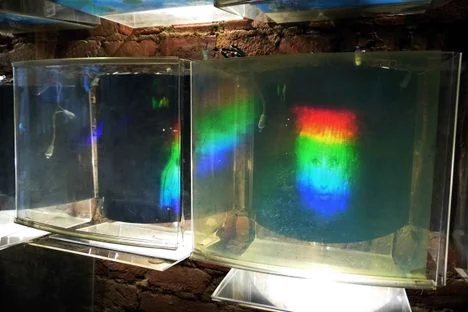
What you see
There is no single artifact to view here; these are institutional records describing what came before and after. By the MIT Museum's own historical note, a visitor to the original Manhattan museum would have found hologram exhibitions, tours, demonstrations and workshops during its run. A researcher today instead finds its surviving archive and object collection, catalogued and held by the MIT Museum in Cambridge, Massachusetts.
How it works
The Museum of Holography operated as an exhibition and education venue and, per the same historical note, published a journal, holosphere, documenting "the application, manufacture, design, development, research, and appreciation of holographic systems, devices, components, and accessories." MIT's Holography Collection page states that when the museum closed, its archive, administrative records, artist files, exhibition documentation, news clippings and holograms transferred to the MIT Museum, which says it "continues to build on the collections acquired from the Museum of Holography in 1993." Historic pieces the page lists as part of that collection include the first reflection holograms, the first laser transmission hologram, and the first white light transmission hologram, credited there to MIT's own Stephen Benton.
Viewing conditions and limits
The Museum of Holography itself no longer exists to visit. MIT's collection page states that archived MOH materials are open to researchers under the museum's own collections-manual policy, while holograms not currently on exhibit are unavailable for viewing "owing to the technical requirements of displaying" them. Neither opened document gives an exact opening date for the original museum; MIT's historical note dates the closure to 1992 and describes a run of "15 years," which places the opening in the mid-1970s without confirming a specific day or month.
What it is not
This is not a still-operating institution under its original name, and the MIT Museum's holography collection is not simply the Museum of Holography relocated; it is a distinct institution that acquired the earlier museum's archive and objects in 1993 and has kept adding new work since. A claim describing a currently open "Museum of Holography" in New York should be checked against this closure record before being repeated.
- Does a referenced "Museum of Holography" match the original institution that closed in 1992, or a later, differently named venue?
- Does a collection claim trace to MOH-originated holograms now held by MIT, or to unrelated pieces?
- Is the museum's founding year independently documented, or only inferred from a stated length of operation?
The Museum of Holography's own successor is careful to describe a transfer, not a survival: an institution closed in 1992, and a different one, already established at MIT, took in its archive the following year. Treating the two as the same ongoing museum overstates what either record actually says.
Sources & reading trail
MIT Museum's own collections page states its holdings include the archives of New York's Museum of Holography, acquired in 1993, and lists specific historic holograms now in the collection.
Source published: 1 January 2008 · Retrieved: 16 September 2026
MIT Museum's own historical note states the Museum of Holography, founded by Rosemary Jackson Smith, served for 15 years before closing its doors in 1992, after which MIT Museum continued its programs and archive.
Source published: Not established · Retrieved: 16 September 2026
Papers, patents, vendor documentation and records establish the entry; the mechanism reading is Hologram Field Guide editorial analysis. This retrospective draft does not imply the site published on the event date.