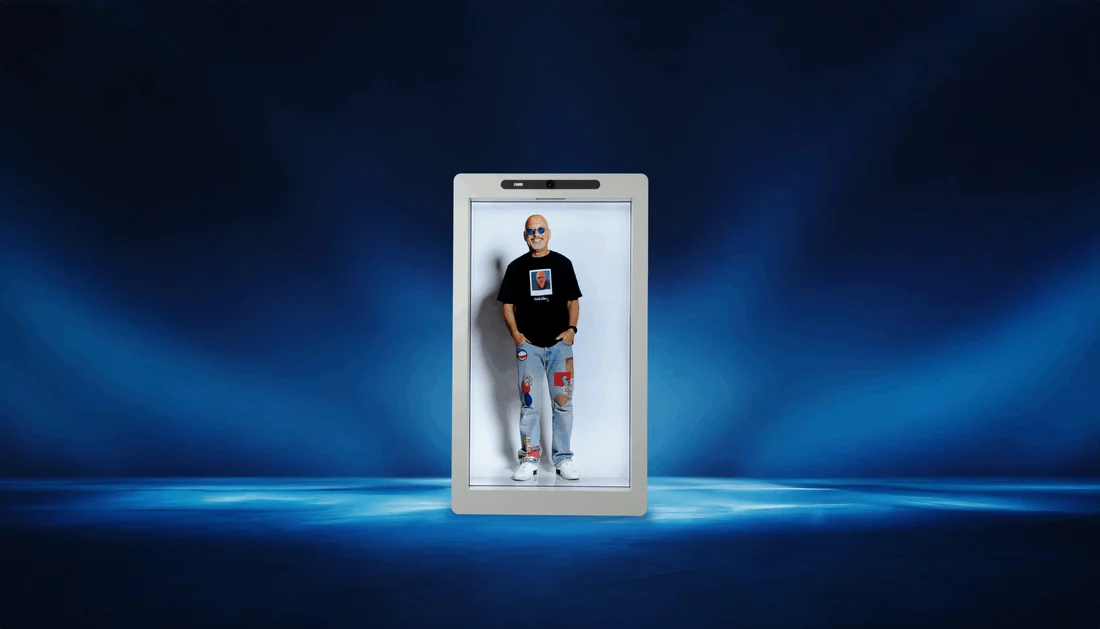
What you see
A Proto unit — the flagship product is the Proto Luma — is a fixed cabinet, roughly 88 by 50 by 24 inches according to Proto's own product page, that shows what the company calls a "life-like and life-size hologram of speakers, celebrities, AI avatars, logos, or 3D visuals" within its frame. The image is viewed from in front of the cabinet, without a headset or glasses; Proto's own FAQ page states the technology "requires no VR headsets or AR glasses" and describes its aim as "headset-free holographic" communication.
How it works
Proto's cited pages describe what the system does, not how it forms the image. The FAQ says the company "invented and patented the world's first and only holographic communications platform," combining "patented holographic hardware, proprietary OS, AI avatars, and spatial computing," and the Luma page adds that content reaches the unit "via the Proto Cloud, connected PC, or camera using WiFi, ethernet, HDMI, or USB connections," including "live beaming" of a speaker in real time. Neither page names the component that turns that signal into a viewable image — no screen, reflective surface, or projector is mentioned. This entry can confirm what Proto claims the system does, not how it does it optically, because the company's own pages do not say.
Viewing conditions and limits
What is confirmed is a fixed-size cabinet with stated dimensions and a multi-touch area the Luma page calls an "86″ Multi-Touch Holographic Display," plus a 4K camera and microphone array. The FAQ's claim of "headset-free" viewing is specific and testable. Neither page confirms a maximum viewing angle, a minimum ambient-light level, or how many people can see the image at once — detail that would let a reader compare Proto's claim against a light-field or volumetric display elsewhere in this archive.
What it is not
One boundary is worth noting as editorial reasoning, not a claim from Proto's own pages: a true interference-recorded hologram is a fixed optical recording that cannot natively carry live, arbitrarily changing video the way the FAQ describes "live beaming" of a speaker in real time. Whatever technique fills a Proto cabinet, its stated ability to show live feeds, AI avatars, and pre-recorded content interchangeably places it with other enclosed, screen-or-reflection "hologram" cabinets in this archive, not recorded-light holography. Proto's phrase "real, interactive presence rather than passive projection" contrasts with AR headsets and flat screens; it is not a technical description a reader can verify from the cited pages.
- Does the company's own technical material name the actual optical component inside the cabinet — a screen, a reflective surface, a projector?
- Can the unit display arbitrary live video, and if so, does that rule out a fixed, pre-recorded interference hologram?
- What does the patent Proto cites actually claim, beyond the word "holographic" in its title?
None of this means Proto's product fails to work as a communication tool for the retail, event, and healthcare settings it targets. It means that, on its own public pages, "holographic" is Proto's chosen name for a patented but unspecified display technique, not a claim its own materials explain optically.
Sources & reading trail
Proto's own product page describes the Luma cabinet's dimensions and an '86″ Multi-Touch Holographic Display' without naming the optical mechanism.
Source published: Not established · Retrieved: 16 September 2026
Proto's own FAQ claims patented 'holographic hardware' and headset-free viewing while not describing how the image is physically formed.
Source published: Not established · Retrieved: 16 September 2026
Papers, patents, vendor documentation and records establish the entry; the mechanism reading is Hologram Field Guide editorial analysis. This retrospective draft does not imply the site published on the event date.