What you see
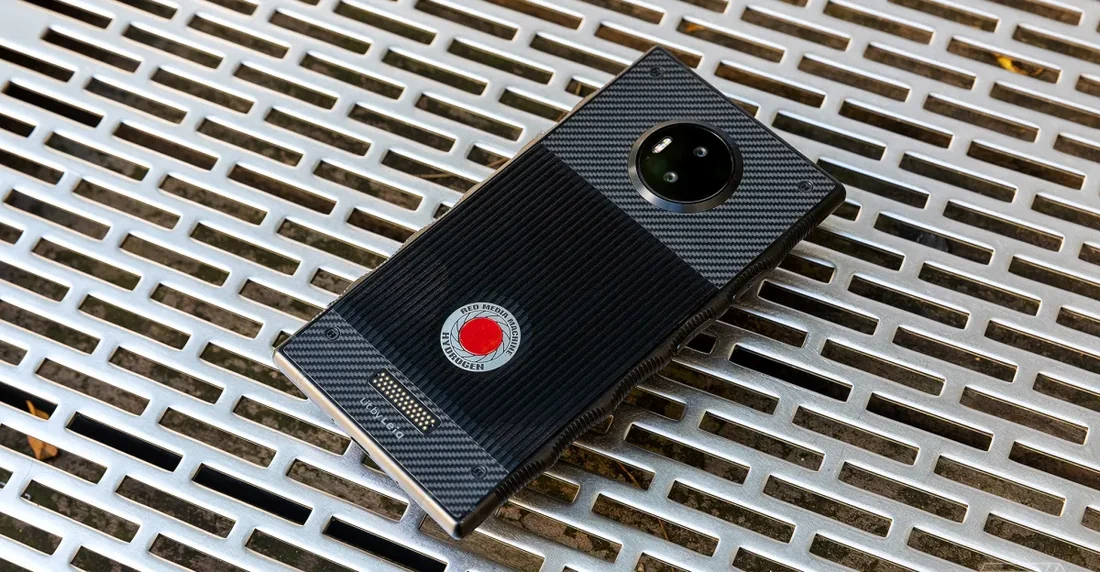
RED's Hydrogen One, a phone marketed at prices from $1,195 to $1,595, showed ordinary flat content most of the time and switched to a glasses-free 3D mode only inside a handful of specially formatted apps and clips. The Verge's October 2018 review describes the effect as a paper cutout placed on top of a flat background, with a noticeably blurrier image whenever 3D mode activated, a real but limited depth effect, not a floating image detached from the screen.
How it works
RED's own archived product page called the device the world's first holographic media machine ... no glasses needed. The screen technology behind that claim came from Leia Inc., whose own archived technical page describes its proprietary Diffractive Lightfield Backlighting solution, which adds nanostructures to a conventional display while keeping its standard imaging layer unchanged. In plain terms, a patterned nanostructure layer sits behind an ordinary LCD panel and redirects light so each eye receives a slightly different image without glasses, an autostereoscopic, multi-view technique, sometimes called 4V in press coverage, rather than one that reconstructs a light field from recorded interference data.
Viewing conditions and limits
Leia's own description frames its backlighting as versatile, suitable for uses as simple as privacy viewing zones or as complex as interactive holograms; the wording shows Leia itself uses hologram loosely for a range of multi-view effects, not exclusively true holography. The Verge's review reported the 3D effect only appeared in a limited set of compatible apps, required a fairly specific head position, and made some viewers dizzy; outside that position or those apps, the phone behaved as an ordinary smartphone display. Neither RED nor Leia published independent optical measurements alongside their marketing claims in the pages reviewed here.
What it is not
This is not a hologram in the optical sense of an interference-recorded wavefront, and it is not a volumetric or light-field display that emits genuinely different light rays across a wide range of angles; it is a parallax-style autostereoscopic panel, closer to older glasses-free 3D televisions than to any coherent-light process. The Verge's review used scare-quoted holographic throughout and judged the holographic display just was not very good, a verdict on execution rather than a technical description, but consistent with Leia's own more modest backlighting language.
- What specific patent or technical filing describes Leia's Diffractive Lightfield Backlighting in enough detail to verify the nanostructure claim independently?
- How many discrete viewing zones did the Hydrogen One's screen produce, compared with other autostereoscopic phone or tablet displays sold before or since?
- Did RED or Leia ever publish an explanation distinguishing their marketing use of holographic from optical holography, given the gap seen in outside reviews?
RED's own marketing chose the word holographic for a phone screen that its own display supplier describes, more precisely, as a diffractive light-field backlight, a real but different technology from coherent-light holography, delivering a limited, sometimes uncomfortable depth effect rather than the free-floating image the marketing name implied.
Sources & reading trail
RED's own marketing tagline calling the phone the world's first holographic media machine, no glasses needed.
Source published: Not established · Retrieved: 16 September 2026
Display supplier Leia Inc.'s own technical description of Diffractive Lightfield Backlighting using nanostructures added to a conventional display.
Source published: Not established · Retrieved: 16 September 2026
Independent review describing the 3D effect's limits (blurriness, narrow viewing conditions, dizziness) and questioning the holographic label.
Source published: 29 October 2018 · Retrieved: 16 September 2026
Papers, patents, vendor documentation and records establish the entry; the mechanism reading is Hologram Field Guide editorial analysis. This retrospective draft does not imply the site published on the event date.