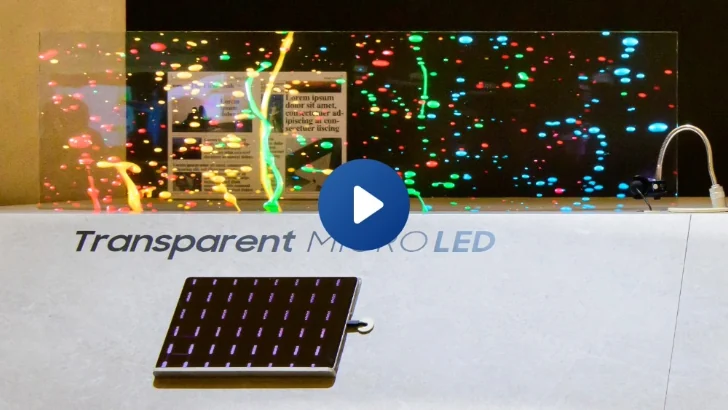
What you see
Samsung's transparent MicroLED panel looks, at a glance, like a sheet of glass with an image floating inside it: a viewer standing in front of the panel sees whatever is behind it, the room, a shelf, another screen, through the gaps between the display's own light-emitting points, while bright picture content appears layered on top. Samsung's own newsroom video post, dated 8 January 2024, describes the panel's 'crystal-clear, glass-like display' and states it was first shown publicly at Samsung First Look 2024 on 7 January, ahead of CES 2024 in Las Vegas.
How it works
Samsung's newsroom describes MicroLED generally, in a separate November 2023 interview with the technology's development lead, as millions of individually addressable inorganic LED chips 'smaller than 50μm in size', each emitting its own red, green or blue light directly, without a color filter or backlight layer. Applied in a transparent configuration, gaps between those self-emitting LED points let light from behind the panel pass through, so the see-through effect comes from the spacing between individually addressable light sources, not from any interference pattern or holographic recording.
Viewing conditions and limits
Samsung's own posts describe this as a modular display, built from smaller panel units joined into a larger surface, the same construction principle behind Samsung's existing 'The Wall' MicroLED product line, though the January 2024 posts describe the transparent version as a newly unveiled concept rather than a shipping consumer product with a stated price or release date. No brightness, transparency percentage, or viewing-angle figure for the transparent variant specifically appears in the Samsung materials retrieved here.
What it is not
Samsung's own newsroom material does not call this display a hologram anywhere in the pages retrieved for this entry; it consistently uses 'Transparent MICRO LED', a self-emissive panel technology built from conventional inorganic LED chips. It should not be confused with a volumetric or free-space display: the image sits on the flat plane of the panel itself, and depth or floating effects come only from what is placed physically behind the transparent glass, not from any 3D projection.
- Does the display use individually addressable LED emitters, or a projected image onto a separate transparent surface?
- Is the product shown a shipping model with a price and release date, or a concept demonstration?
- Does the vendor's own material ever use the word hologram, or is that a label added elsewhere?
Samsung's own account of its transparent MicroLED work is mechanism-first: individually addressable, self-emitting inorganic LEDs spaced to let light through, unveiled as a concept ahead of CES 2024, with no holographic claim attached in the company's own words.
Sources & reading trail
Samsung's own announcement that the Transparent MICRO LED display was first shown at Samsung First Look 2024 on 7 January, ahead of CES 2024.
Source published: 8 January 2024 · Retrieved: 16 September 2026
Samsung's technical description of MicroLED as millions of individually addressable, self-emitting inorganic LED chips smaller than 50 micrometers.
Source published: 6 November 2023 · Retrieved: 16 September 2026
Papers, patents, vendor documentation and records establish the entry; the mechanism reading is Hologram Field Guide editorial analysis. This retrospective draft does not imply the site published on the event date.