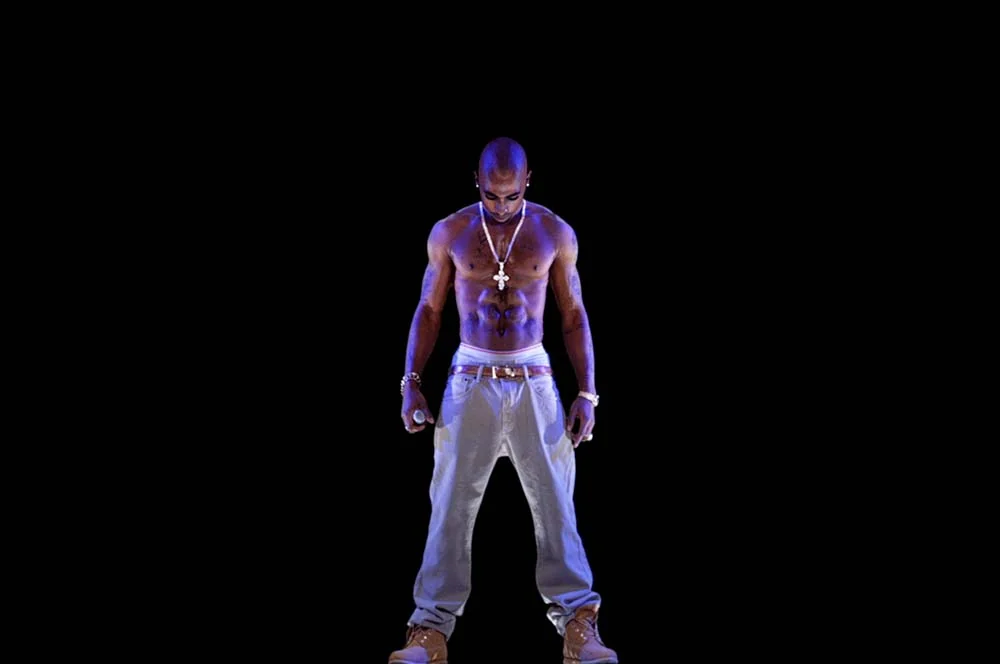
What you see
At the 2012 Coachella Valley Music and Arts Festival, festivalgoers standing in front of the stage saw a life-size figure resembling Tupac Shakur walk out, address the crowd and perform two songs alongside Snoop Dogg. According to Musion's own case study, the image appeared solid enough that a live performer could walk around it and appear to sync movement with it. There was no headset or glasses involved: the effect was built for a stadium audience of about 90,000 people looking at the stage from the crowd, and it was also captured on video and broadcast far beyond the festival grounds.
How it works
Musion's case study credits three separate contributors: Digital Domain built the moving, speaking digital likeness from archival footage and new choreography; AV Concepts handled on-site production and installation; and Musion supplied the projection technique it markets as Eyeliner. AV Concepts' own portfolio page describes 'projecting the illusion of a life-sized Mr. Shakur on stage,' language consistent with a rear-projection, angled-reflective-surface illusion rather than an interference-recorded hologram. Neither page names the specific foil or screen used, but both describe a projected image bounced toward the audience, the family of techniques often grouped under the Pepper's ghost name even when marketed as 'holographic.'
Viewing conditions and limits
The illusion depends on the audience viewing from within the stage-facing seating and standing areas, under controlled festival lighting at night; Musion's page notes 90,000 people watched the performance in person, which the vendor treats as evidence of scale rather than of the image being visible from any angle or in daylight. Digital Domain spent, per the same case study, close to four months building the animated content before the one-time appearance, underscoring that this was a bespoke production rather than a repeatable off-the-shelf display. Neither source states a specific viewing angle, screen brightness or size limit, so those figures remain unconfirmed by the vendors themselves.
What it is not
This is not a free-space or interference-recorded hologram: no laser-recorded interference pattern was involved, and the image existed only as long as the projection and staging were running, visible from the audience-facing side rather than from all around. It is closer to a large-scale theatrical rear-projection illusion, the same broad family of trick used in older Pepper's ghost effects, rebuilt with modern CGI content and a proprietary foil or screen system. Musion and AV Concepts both use the word 'hologram' throughout their own marketing copy, which is the vendors' own branding choice rather than an optical classification.
- Ask the vendor whether the effect requires a physical screen or foil in the sightline, or whether it is a true free-space image.
- Ask how many separate viewing positions were tested and whether the illusion holds from the back or sides of the venue.
- Ask which company supplied the projection hardware versus the digital content, since press coverage often credits only one.
The Coachella performance is a useful anchor case precisely because its own producers are unusually explicit about the division of labor between content creation and projection technique, even while marketing the result as a 'hologram.'
Sources & reading trail
Musion's own case study credits AV Concepts for installation, Digital Domain for visual effects, and its Eyeliner projection technique for the on-stage illusion, and states the audience size.
Source published: Not established · Retrieved: 16 September 2026
AV Concepts' own portfolio page describes projecting the illusion of a life-sized performer on stage and the production process used.
Source published: Not established · Retrieved: 16 September 2026
Papers, patents, vendor documentation and records establish the entry; the mechanism reading is Hologram Field Guide editorial analysis. This retrospective draft does not imply the site published on the event date.