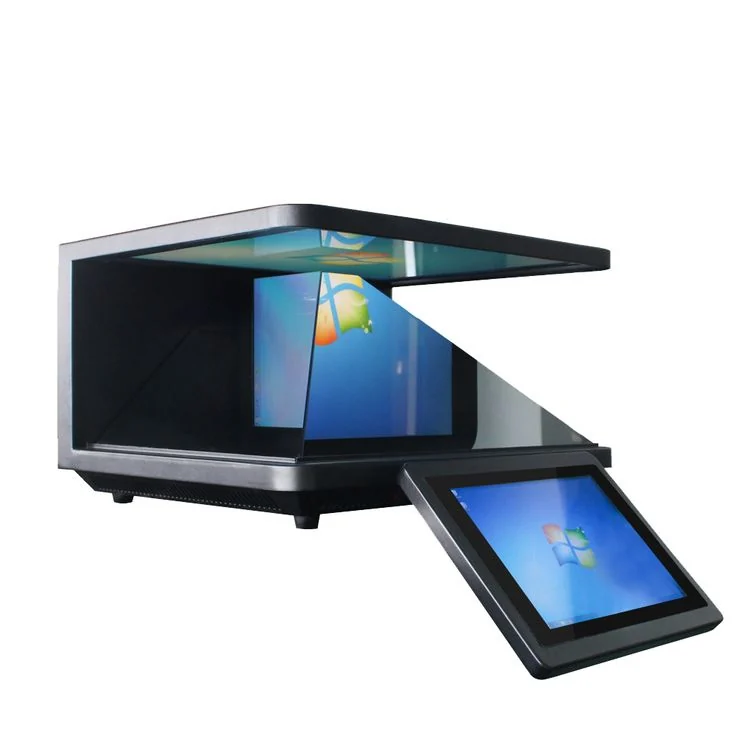
What you see
The Perspecta display was a self-contained unit, roughly waist-high, with a clear dome on top inside which a full-color image appeared to float, visible from any side as you walked around it. Actuality Systems' own product page for the 1.9 system advertised "Spatial 3-D. Floating, hologram-like, interactive imagery" with "full parallax" and a "360-degree field of view," meaning the picture genuinely changed as a viewer moved, unlike a flat video loop. A company press release from February 2004 described the same product as showing imagery that occupies a volume of space "much like a hologram," a careful hedge, not a claim of true holography.
How it works
An earlier product-operation page from the prototype era lays out the mechanism plainly: a high-resolution projector fires thousands of images per second, each one a thin two-dimensional slice of the three-dimensional dataset, onto a projection screen that spins at 600 rpm in step with a set of rotating mirrors. Persistence of vision merges the rapid sequence of slices into a solid-looking image built from what the company called voxels, addressable points in three-dimensional space. This is a swept-volume rasterized display, not a photographic interference recording; the 1.9 model refined the approach to 198 slices of 768-by-768 pixels each. The mechanism is also documented in the company's own 1998-filed, 2001-granted patent for a rotating display target that forms a three-dimensional image from a projected sequence.
Viewing conditions and limits
The 1.9 unit produced a 10-inch, 25-centimeter, diameter image with a 360-degree horizontal and 270-degree vertical field of view, autostereoscopic and viewable by several people at once without goggles, per the company's own specifications. Image size was capped by the dome's dimensions, and resolution was limited by how many slices the projector and mirrors could sweep per rotation. Because Actuality Systems closed years ago, none of these figures can be independently re-measured; they stand as the manufacturer's own stated specifications, preserved only in archived form.
What it is not
Perspecta was not an interference hologram recorded on photographic film, and the company's own language, hologram-like, reflects that distinction. It is also not a light-field display, which reconstructs many simultaneous viewing angles from stacked or diffracted light rather than a single spinning screen.
- Does an archived spec sheet or patent describe the actual mechanism, or only the visual effect?
- Is the field of view and image size a measured figure or a marketing claim, and can it still be verified given the company's closure?
- What happens to image quality at the edges of the display volume, where slice density is lowest?
Actuality Systems folded years after Perspecta's debut, and its patents and product pages now survive mainly through the Wayback Machine. That fragility is itself a lesson: a defunct company's technical claims can still be checked against an actual patent record, but only for as long as someone keeps the snapshots. Read against its own materials, Perspecta was a genuinely three-dimensional, full-parallax display, and a mechanically real, not photographically recorded, one.
Sources & reading trail
Describes the rotating-mirror, spinning-screen projection mechanism and voxel-based rendering.
Source published: Not established · Retrieved: 16 September 2026
States field of view, image size, slice count and the company's own hologram-like description.
Source published: 1 January 2005 · Retrieved: 16 September 2026
Dated 2004 company press release describing Perspecta as occupying volume much like a hologram and listing applications.
Source published: 4 February 2004 · Retrieved: 16 September 2026
Patent record for the rotating display-target mechanism assigned to Actuality Systems, filed 1998, granted 2001.
Source published: 6 February 2001 · Retrieved: 16 September 2026
Papers, patents, vendor documentation and records establish the entry; the mechanism reading is Hologram Field Guide editorial analysis. This retrospective draft does not imply the site published on the event date.