What you see
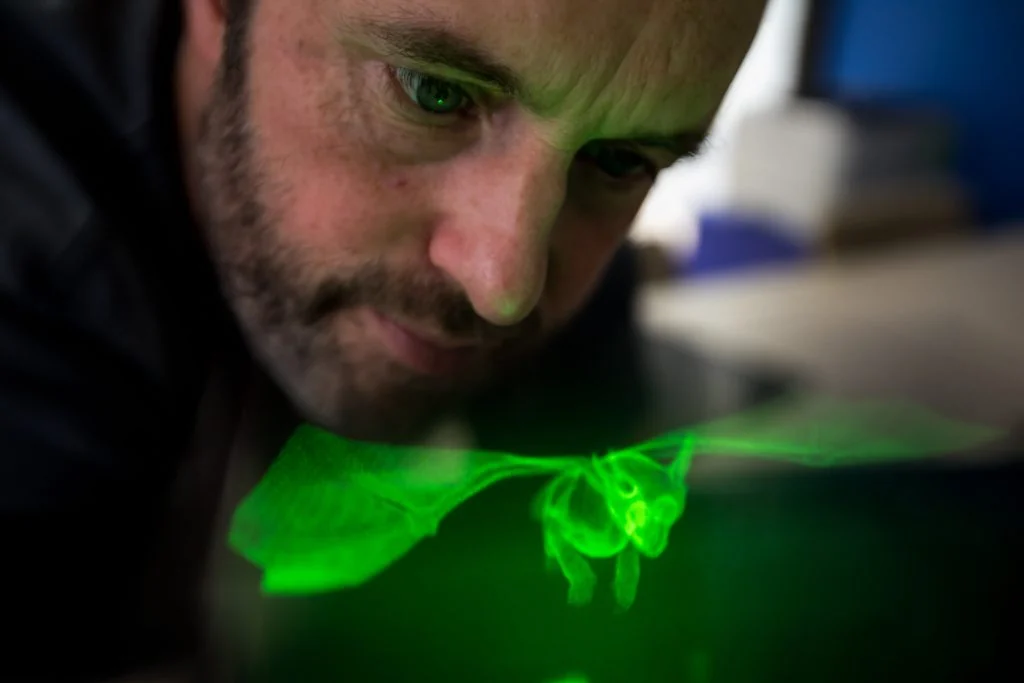
A Voxon VX1 shows a glowing three-dimensional shape hanging inside a small clear enclosure, readable from any side without glasses or a headset. The company's own 2019 blog post, The technology behind the Voxon 3D Volumetric Display, describes walking around the unit the way one would walk around a real object, and its 2017 purchase announcement lists early buyers as schools and universities using it for teaching and demonstrations.
How it works
Voxon's technical post describes an ultra-high-speed light engine paired with a volume-rendering engine that slices a 3D scene into hundreds of horizontal cross-sections. Those slices are projected in rapid synchronized sequence onto a specially built screen that reciprocates, moving back and forth through the display volume many times per second. As each slice lands on the screen at the right depth, light diffuses off it at the correct physical location; the human eye's persistence of vision blends the hundreds of sequential slices into what reads as one solid volumetric shape. This is a swept-surface, persistence-of-vision display, not a hologram recorded from an interference pattern.
Viewing conditions and limits
Voxon's own description states the engine projects over half a billion points of light per second and requires no special glasses, headset, or fixed viewing position; the shape can be viewed from any angle around the enclosure, and the company markets this specifically as a shared, walk-around experience for classrooms, trade shows, and clinics. Neither archived page gives an independently measured brightness, refresh-rate, or maximum-object-size figure; those numbers are the company's own engineering claims, and the physical display volume is bounded by the size of the enclosure and reciprocating screen rather than being open or unlimited in space.
What it is not
Voxon's own post draws a useful contrast: it explicitly distinguishes the VX1 from the Coachella 2012 Tupac appearance, which it correctly describes as a Pepper's ghost illusion, a two-dimensional reflection rather than a volumetric object. The VX1 is also not an interference hologram, since no coherent laser light or recorded wavefront is involved, and it is not augmented or virtual reality, since nothing is worn on the head. Even so, Voxon's own marketing repeatedly calls the result a true 3D hologram, which is accurate only if hologram is read loosely as any three-dimensional image rather than in its original interferometric sense.
- Ask whether a volumetric display claim refers to a genuinely walk-around image or a single-angle projection trick.
- Ask how large an object the display volume can actually hold before clipping occurs.
- Ask whether content was authored natively in 3D or converted from flat video.
Voxon's persistence-of-vision approach is a real, physically distinct alternative to both Pepper's ghost and headset-based 3D, and its own documentation is unusually direct about naming that difference, even while choosing to market the result under the hologram label the site's broader lane exists to question.
Sources & reading trail
Company's own explanation of the swept-screen, persistence-of-vision mechanism and its explicit contrast with Pepper's ghost.
Source published: Not established · Retrieved: 16 September 2026
Documents the VX1 commercial launch, early education-sector buyers, and lease options for events.
Source published: 3 October 2017 · Retrieved: 16 September 2026
Papers, patents, vendor documentation and records establish the entry; the mechanism reading is Hologram Field Guide editorial analysis. This retrospective draft does not imply the site published on the event date.