What you see
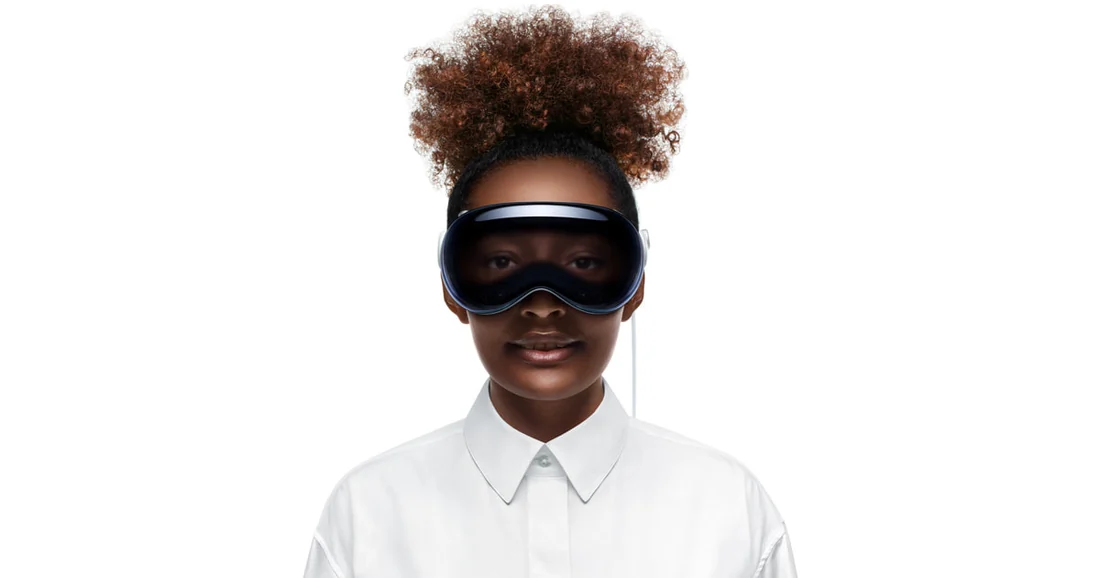
Apple made Vision Pro available in the United States on 2 February 2024. Its own newsroom release calls it ‘a revolutionary spatial computer,’ never a hologram device, and describes ‘micro-OLED technology to pack 23 million pixels into two displays, each the size of a postage stamp.’ The product page explains how the wearer sees the room at all: ‘a pair of high-resolution cameras transmit over one billion pixels per second to the displays so you can see the world around you clearly.’ The room is not seen through transparent optics but relayed as live camera video onto the same internal displays showing digital content.
How it works
Apple’s June 2023 unveiling release introduced the same framing — Tim Cook is quoted saying ‘Apple Vision Pro introduces us to spatial computing’ — and describes visionOS as blending ‘digital content with the physical world.’ That blending happens computationally: outward-facing cameras capture the surroundings, and software composites virtual windows, apps, and objects into that video feed in real time, rather than any optical waveguide or projector combining light from the real world with a separate image source. The product page also describes EyeSight, an external display that shows an approximation of the wearer’s eyes to people nearby, letting them see the wearer while the wearer sees them through the internal camera feed.
Viewing conditions and limits
Because the surrounding world reaches the wearer only as digitized camera video, latency and camera quality — not transparency — govern how natural the passthrough looks; Apple’s own figure of ‘over one billion pixels per second’ is the company’s claim about that video pipeline, not an independently measured figure. Neither cited page gives a field-of-view number, and neither claims the displayed content is visible to anyone but the wearer; a bystander sees only the headset’s outer shell and, if EyeSight is active, an image of the wearer’s eyes on that shell.
What it is not
Apple’s own newsroom material never uses the word ‘hologram’ for Vision Pro, and the mechanism it describes — camera-relayed video composited with rendered graphics on two internal micro-OLED panels — is a passthrough mixed-reality display, not a see-through waveguide headset like HoloLens and not a free-space or light-field hologram viewable without a device. The absence of the word across two separate press releases, thirteen months apart, reflects a consistent choice in the company’s own vocabulary.
- Does the headset let ambient light reach the eye directly, or is the surrounding world relayed as camera video, as Apple describes for Vision Pro?
- Is a stated pixel or resolution figure about the display panels, the passthrough camera pipeline, or both?
- Does the manufacturer ever use the word ‘hologram,’ or does it consistently avoid the term, as Apple's own releases do?
Vision Pro’s launch materials describe a specific, named mechanism — passthrough video plus micro-OLED displays — and Apple’s own choice never to call the result a hologram is as informative as the specification numbers it does publish.
Sources & reading trail
Apple's own availability announcement calling the device a spatial computer with micro-OLED displays, never using the word hologram.
Source published: Not established · Retrieved: 16 September 2026
Describes the passthrough camera pipeline that relays the physical world onto the internal displays, and the EyeSight external display.
Source published: Not established · Retrieved: 16 September 2026
The original unveiling release, framing the device as a spatial computer that blends digital content with the physical world, without using the word hologram.
Source published: 5 June 2023 · Retrieved: 16 September 2026
Papers, patents, vendor documentation and records establish the entry; the mechanism reading is Hologram Field Guide editorial analysis. This retrospective draft does not imply the site published on the event date.