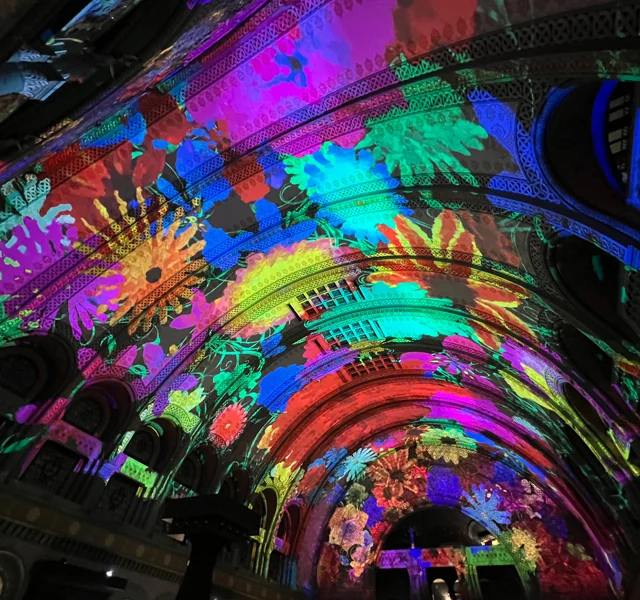
What you see
A building facade, vehicle, or stage set appears to change colour, texture, or shape, or plays animated video, as though the surface itself were a screen. Any bystander can watch, no glasses needed, usually in a darkened venue for contrast. One projector or several stitched together can cover a large or oddly shaped surface.
How it works
Conventional projectors throw light at the physical object; because the surface is not flat, Christie's own page states content is prepared against 'a building, landmark, 3D object, dome, curved surface, or a simple flat screen,' then warped and blended to fit. Christie names two of its own tools for this: Christie Twist for manual edge-blending and stacking multiple projectors, and Mystique, camera-based software that 'automatically aligns, stacks, and blends multi-projector systems' in minutes. Barco separately describes joining Scalable Display Technologies on a camera-based auto-alignment tool built into its Pulse platform.
Viewing conditions and limits
Christie's own FAQ states environmental conditions matter directly: 'rain can make a light surface darker and mute colours,' and installers must weigh 'wind, temperatures, and moisture,' plus 'the amount of ambient light, distance from the projection surface,' and obstructions. Alignment is not one-time either; Barco's announcement calls aligning multiple projectors 'one of the trickiest parts of immersive installations,' which is why dedicated auto-alignment products exist for re-checking it as rigging, wind, or temperature shift the setup.
What it is not
This is not a hologram or a free-space image: the video lands on a real physical surface that scatters light back to the viewer, and nothing outside that surface is shown. Unlike the light-field or interference-based displays elsewhere in this guide, the '3D' invoked in marketing usually means the real physical shape being painted with light, not any recorded stereoscopic depth in the image itself. Barco's own page calls the result 'technological magic,' language this entry treats as the company's framing, not a technical description.
- Does the projection change the object's apparent shape by mapping onto its real geometry, or is it meant to look like a separate floating image?
- How many projectors are stacked, and what edge-blending or warping software aligns them?
- What ambient-light and surface-colour assumptions was the design built around, since these determine whether it reads well at the actual venue?
Projection mapping is real-time light painted onto a real surface, and its own vendors describe the warping, blending, and alignment software that makes that painting line up, not any recorded three-dimensional image.
Sources & reading trail
Christie's own page names Christie Twist (edge-blending) and Mystique (camera-based automated warping, aligning, and blending) as its tools for fitting video to irregular surfaces, and its FAQ describes environmental factors affecting outdoor projection mapping.
Source published: Not established · Retrieved: 16 September 2026
Barco's own page describes projection mapping as a 3D video projection technique for irregular surfaces and describes a camera-based auto-alignment tool developed with Scalable Display Technologies.
Source published: Not established · Retrieved: 16 September 2026
Papers, patents, vendor documentation and records establish the entry; the mechanism reading is Hologram Field Guide editorial analysis. This retrospective draft does not imply the site published on the event date.