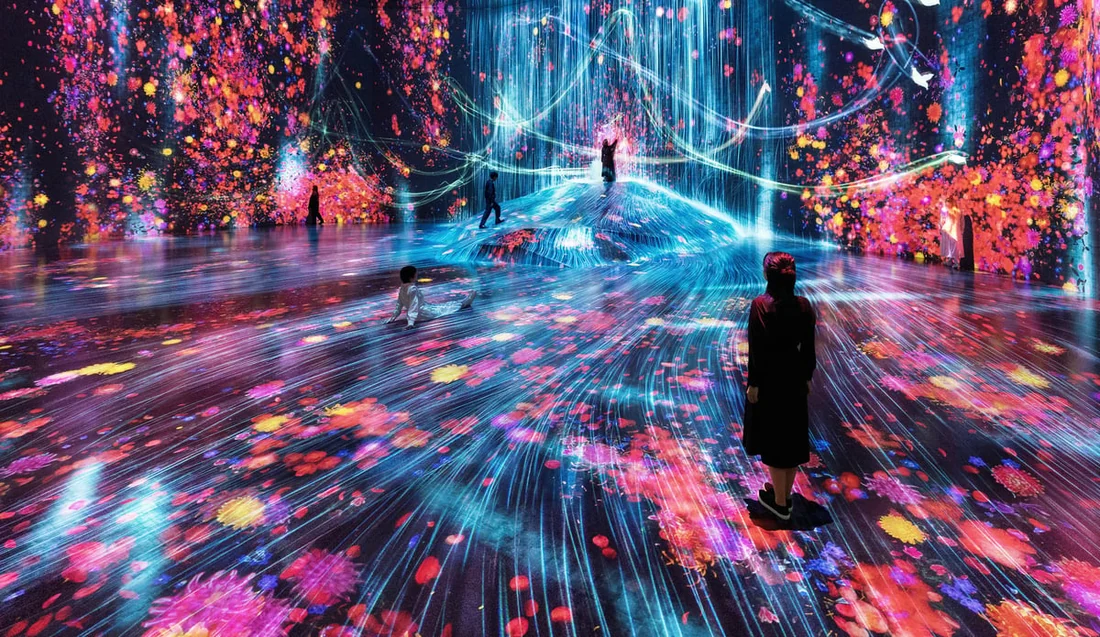
What you see
Inside teamLab Borderless, since February 2024 housed within the Mori Building Digital Art Museum at Azabudai Hills, Tokyo, after relocating from Odaiba, visitors walk unguided through darkened rooms where color, pattern and animated imagery cover walls, floors and sometimes other visitors. There is no seating, no single vantage point, and no wearable device; teamLab's own venue information page, retrieved 16 September 2026, tells visitors not to touch the projectors, sensors, lights, and other equipment, naming the actual hardware rather than describing the work in mystical terms. The museum's own biography page states the Tokyo location has drawn more than four million visitors from over 185 countries since relocating.
How it works
teamLab's own conceptual writing describes interactive works, part of a series it calls Resonant Collective Sculpture and Digitized Nature, as built from sensing, networks, light and sound layered onto elements so a person's movement, touch or proximity changes nearby imagery. One example, teamLabBall, is described as synchronized by wireless peer-to-peer networking, so each object communicates its state to its neighbors rather than following one fixed loop. Combined with the visitor notice naming projectors and sensors, the picture is a real-time computer graphics system: sensors read where people are, software renders new imagery, and projectors throw it onto the room's surfaces continuously, rather than replaying a pre-shot film.
Viewing conditions and limits
Because the images are computer-generated and projected rather than emitted from a volumetric source, what a visitor sees depends on which wall or floor panel is nearby and how many other visitors are affecting the sensors at once; teamLab's material stresses that the body, other people and surrounding artworks all feed the same responsive field, so no two visits look identical. The venue is intentionally dim to keep projected color visible, and guidance treats the hardware as delicate. teamLab does not publish projector counts, sensor types or resolution figures on the pages reviewed here, so specifics beyond projectors, sensors, lights remain the retrieved wording.
What it is not
Nothing in teamLab's own description supports calling Borderless a hologram: the imagery is projected onto ordinary walls and floors and disappears if a projector is blocked, unlike a light-field or volumetric display that emits image data from within a defined volume of space. It is closer to interactive projection mapping than to any single-artwork hologram display, and unlike a headset-based experience, everyone shares the same physical surfaces and, to a degree, the same responsive artwork.
- Which specific rooms use real-time sensor-driven rendering, as described in teamLab's concept notes, versus a fixed projected loop?
- How does the museum define or measure its attendance figures, and over what period do the four-million-visitor numbers run?
- What sensor technology, camera-based, infrared, or other, actually drives the interactivity, since the venue notice names sensors without specifying type?
teamLab's own visitor notices and concept pages describe a projection-and-sensor artwork, not a hologram, and the museum's relocation and attendance record are facts the institution reports about itself. Readers curious about the underlying hardware should treat digital art museum as the more precise label the studio itself uses.
Sources & reading trail
teamLab's own visitor guidance names projectors, sensors and lights as the venue's equipment.
Source published: Not established · Retrieved: 16 September 2026
teamLab's own description of sensing, networked light and sound response mechanisms behind its interactive works, including wireless peer-to-peer teamLabBall.
Source published: Not established · Retrieved: 16 September 2026
teamLab's own venue history: relocation to Azabudai Hills in February 2024 and reported attendance figures.
Source published: Not established · Retrieved: 16 September 2026
Papers, patents, vendor documentation and records establish the entry; the mechanism reading is Hologram Field Guide editorial analysis. This retrospective draft does not imply the site published on the event date.