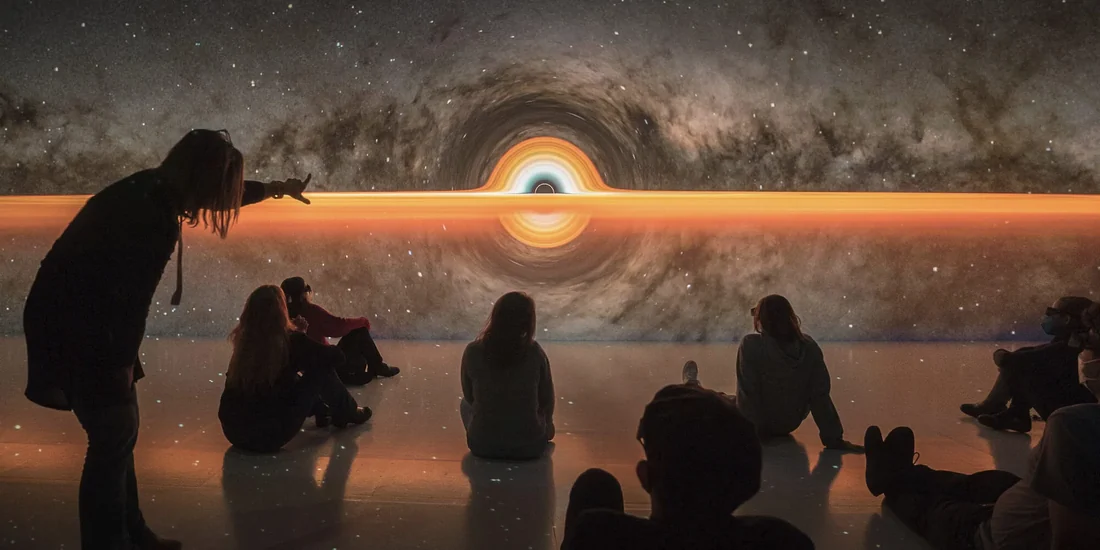
What you see
Walk into Ars Electronica Center's Deep Space in Linz, Austria, and you stand in a room with two enormous flat images: one covering a 16-by-9-metre wall, the other an equally large floor, both lit at once. No headset or glasses are issued; the institution's own Deep Space 8K page, retrieved 16 September 2026, describes visitors moving through the room while imagery such as planetary surfaces, anatomical models and archaeological sites wraps around the wall-floor corner. The content is scientific and artistic visualization delivered as a daily program of talks, art and school visits, not a stage performance.
How it works
The mechanism the venue names is projection at very high combined resolution, not interference holography or volumetric light emission. The center's own page states the room delivers fifty million pixel resolution across its two projection surfaces, the sum of multiple high-resolution projectors tiled to cover the wall and floor rather than one exotic display technology. A high-performance laser tracking system, in the institution's words, follows a presenter's position so a live operator can point at or manipulate the projected imagery in real time, turning a flat image into an interactive lecture tool. The center's overview page confirms Deep Space sits inside the Linz museum and is bookable as an event space, one exhibit within a larger science-and-media museum.
Viewing conditions and limits
Because the image is a projection onto two fixed surfaces, viewing works within the room facing the wall; visitors at extreme angles or close to the floor see the same pixels as everyone else, not a personalized 3D view, and there is no parallax reward for moving your head the way a light-field display would give. Brightness depends on keeping room lighting low, standard for any large-throw projection. The pixel and laser-tracking figures are the institution's own retrieved claims; the pages reviewed publish no independent resolution measurements.
What it is not
Deep Space 8K is not a hologram in any optical sense and the center does not call it one: there is no coherent-light interference recording and no image suspended in open air. It is also not a headset-based virtual-reality space; nobody wears a display, and everyone sees the same shared wall and floor images at once, closer to an immersive cinema or planetarium than a personal VR rig. That shared, headset-free viewing is worth keeping in mind whenever immersive or 8K branding gets paired with claims of individualized 3D depth.
- How many physical projectors combine to reach the quoted fifty-million-pixel total, and how are the wall and floor images kept aligned at their shared edge?
- What does the laser tracking system actually track, a presenter's body, a handheld device, or both, and how precise is it in practice?
- Which listed use, art, science visualization or education, makes up most of the daily schedule?
The venue's own account is a useful model for describing a large projection space honestly: name the pixel count, name the tracking hardware, and let immersive describe the room rather than implying the image itself is free-floating.
Sources & reading trail
Institution's own description of dual 16x9m wall/floor projection at 50 million pixel resolution, laser tracking, and uses for art and science visualization.
Source published: Not established · Retrieved: 16 September 2026
Institution's own overview page confirming Deep Space 8K's location within the Linz museum and its role as a bookable exhibition/event space.
Source published: Not established · Retrieved: 16 September 2026
Papers, patents, vendor documentation and records establish the entry; the mechanism reading is Hologram Field Guide editorial analysis. This retrospective draft does not imply the site published on the event date.