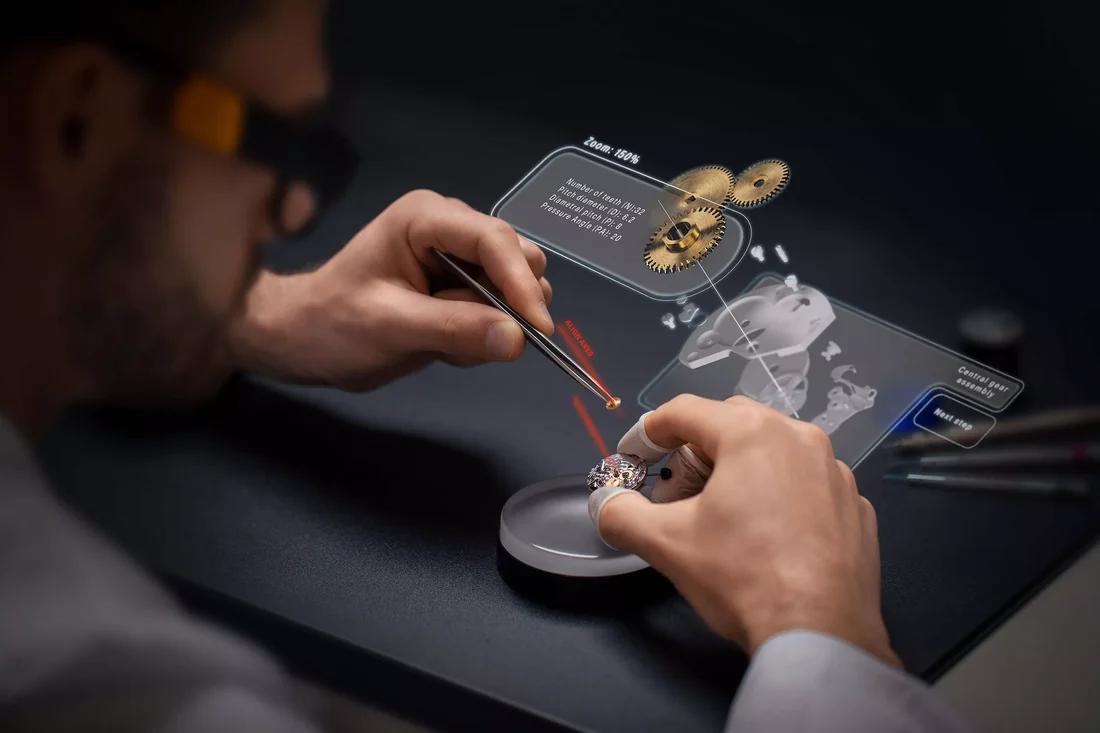
What you see
CREAL's technology is a display engine meant to sit inside AR or VR headsets, not a headset a reader can buy today. Looking through a CREAL-equipped combiner, the company says a viewer should be able to focus their eyes on a virtual object at its intended distance, near or far, the same way they focus on a real one, rather than staring at content that always sits at one fixed depth regardless of where it appears to be. CREAL's own technology page states its display 'enables a natural and healthy visual experience in AR with no trade-off on image quality.'
How it works
CREAL calls this a light field display: rather than showing one flat image at a fixed focal plane, as CREAL's page says 'most of today's headsets' do, the system reconstructs multiple rays of light per point so the eye's own lens can focus at different apparent depths. The engine driving it is a proprietary component CREAL calls 'C·Bast', described in the company's November 2025 technical post as a ferroelectric liquid crystal on silicon (FLCoS) microdisplay running at up to 8 kHz, paired with a 'waveguide-compatible pixel replication system' meant to feed a wide field of view through the same kind of waveguide combiners used in AR glasses, rather than replacing them.
Viewing conditions and limits
CREAL states its transparent-lens design allows 'natural eye contact' and that the approach targets low power draw and manufacturability at scale, but the company's own materials describe this as a display technology for AR and VR headset makers to license and integrate, not a specification for a finished consumer product. No shipping date or named consumer headset using CREAL's engine appears on the pages retrieved here, and third-party commentary quoted on CREAL's own site, from outlets such as RoadtoVR and The AR Show, is clearly marked as outside reviewer reaction rather than CREAL's own technical claim.
What it is not
CREAL's light field approach is not the same thing as ordinary stereoscopic 3D, which shows each eye a separate flat image at one fixed focus regardless of an object's apparent distance; CREAL's stated goal is specifically to solve that mismatch, sometimes called the vergence-accommodation conflict, by giving the eye real focus cues. It is also not a free-space hologram: the image still requires a headset display and combiner, and CREAL's own posts describe it as a component for near-eye AR and VR optics, not open-air projection.
- Is this a shipping headset, or a display component that still needs a device built around it?
- Does the vendor claim to solve focus-distance mismatch specifically, and if so, by what mechanism?
- Are quoted reviewer impressions clearly distinguished from the company's own technical specifications?
CREAL's own materials are consistent that this is unfinished, component-level work aimed at a known optical problem in AR headsets, described with real technical detail about frame rate and pixel replication, but without a named shipping consumer product to point to yet.
Sources & reading trail
States CREAL's light field display reconstructs real image depth to address focal-distance conflicts in AR, as opposed to flat fixed-focus displays.
Source published: Not established · Retrieved: 16 September 2026
Describes the FLCoS microdisplay engine, its 8kHz frame rate, and a waveguide-compatible pixel replication design meant to pair with AR waveguide combiners.
Source published: 18 November 2025 · Retrieved: 16 September 2026
Papers, patents, vendor documentation and records establish the entry; the mechanism reading is Hologram Field Guide editorial analysis. This retrospective draft does not imply the site published on the event date.