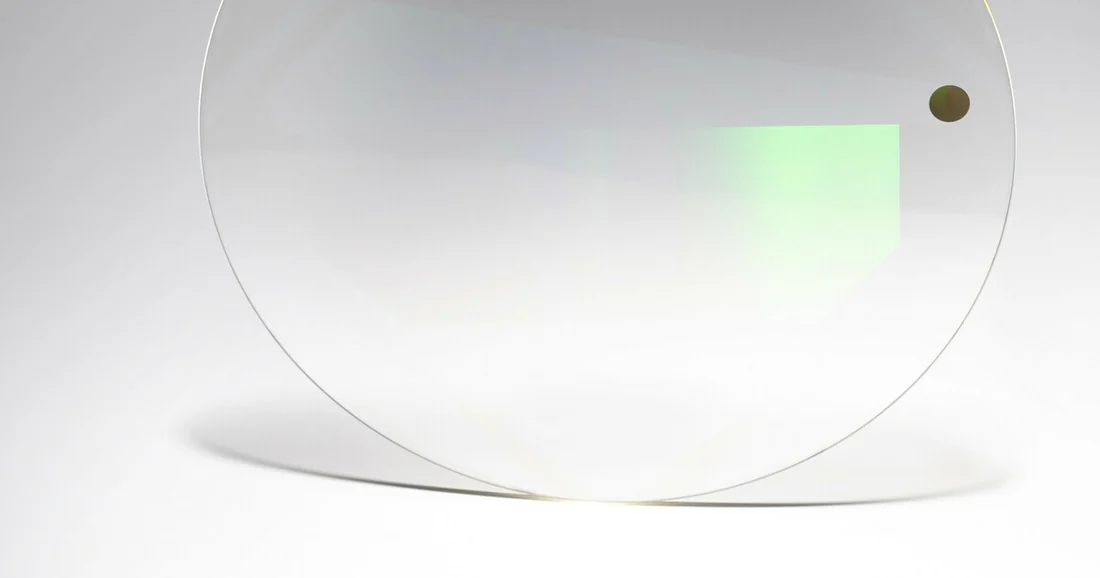
What you see
Dispelix does not sell a headset; it supplies the transparent optical combiner that sits in front of a wearer's eye inside AR glasses made by other companies. Looking through one of these combiners, a wearer sees ordinary daylight and surroundings passing through a thin, glasses-like piece of glass or plastic, with a projected image appearing to hover in front of that scene. Dispelix's own technology page describes its waveguides as 'see-through, full-color waveguide displays for a wide range of AR devices, from near-eye to head-up.'
How it works
Dispelix's optical see-through XR displays explainer lays out the physics: a waveguide combiner traps light inside a glass or polymer plate by total internal reflection, then uses microstructures to couple an image in and back out toward the eye. The explainer distinguishes 'reflective optical elements', which use micron-scale mirror facets to redirect light, from 'diffractive optical elements', which bend light through interference at sub-wavelength grating structures; Dispelix states its own core technology is 'founded on pioneering work in the design and fabrication of surface relief diffraction gratings', a specific class of diffractive element rather than the reflective, mirror-facet approach some competitors use.
Viewing conditions and limits
Dispelix's explainer states the diffracted image is 'formed at optical infinity', meaning the wearer's eye focuses on it as though it were far away regardless of the combiner's physical thinness, a property common to waveguide AR displays generally. The company describes its patent portfolio, reaching 200 granted patents by an April 2024 company announcement, as covering grating structures, manufacturing processes and light engines, evidence of manufacturing scale rather than of any specific optical performance figure like field of view or brightness, which Dispelix's public pages do not quote for a named product here.
What it is not
A diffractive waveguide is not the same mechanism as a reflective waveguide, even though both are called AR combiners: Dispelix's own explainer separates them by physical principle, mirror facets against grating diffraction, and states surface relief gratings are its specific specialty. Neither type is a free-space or interference-recorded hologram; the image is still generated by a conventional light engine and merely relayed to the eye through the waveguide's structure.
- Does the supplier's page specify a reflective, diffractive, or holographic optical element, and can the difference be explained in one sentence?
- Is the described component a finished consumer product, or an optical part meant for another company's headset?
- What patent or manufacturing evidence, if any, backs a claim of production scale?
Dispelix's own technical writing is unusually precise about mechanism, naming diffraction and surface relief gratings specifically rather than reaching for the word waveguide alone, which is useful because 'waveguide' by itself covers at least three physically distinct ways of getting an image to an eye.
Sources & reading trail
States Dispelix builds see-through, full-color diffractive surface relief grating waveguides for AR devices.
Source published: Not established · Retrieved: 16 September 2026
Distinguishes reflective optical elements from diffractive optical elements in waveguide combiners and explains the total-internal-reflection mechanism.
Source published: Not established · Retrieved: 16 September 2026
Confirms Dispelix's granted patent count and portfolio scope as of April 2024.
Source published: 29 April 2024 · Retrieved: 16 September 2026
Papers, patents, vendor documentation and records establish the entry; the mechanism reading is Hologram Field Guide editorial analysis. This retrospective draft does not imply the site published on the event date.