What you see
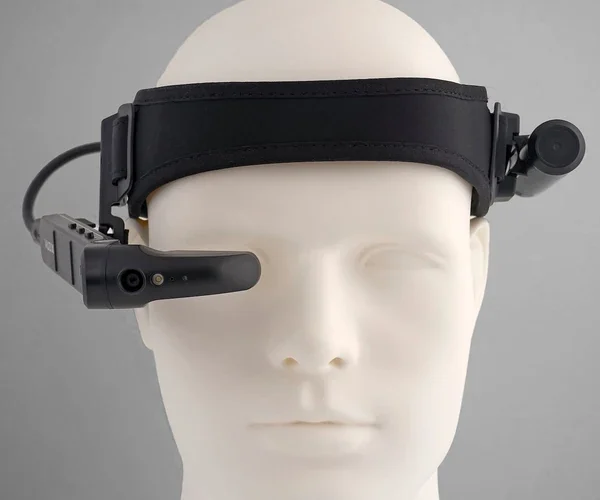
Put on a Vuzix Blade and the world stays visible through ordinary-looking lenses, with a color panel appearing to float in view while the wearer still sees the room ahead. Put on a Vuzix M400 and there is no lens to look through: a small screen sits on a boom near one eye, glanced at like a wrist display, then left behind. Vuzix's own archived Blade product page shows sunglasses with a lens-mounted image; its current M400 specification page shows a headset with a projecting arm and a small display module instead.
How it works
The Blade page states the device uses 'waveguide based see through optics' driven by a 'Cobra II DLP based display': a digital micromirror projector injects an image into a thin waveguide that carries the light by internal reflection and steers it toward the eye, while ambient light passes through the same waveguide largely unimpeded, so image and scene share one optical path. The M400 page describes something else. Its optics section lists 'display type: OLED', an 'nHD color display' at a 16.8-degree diagonal field of view, 'equivalent to a 5 in. mobile device screen seen at 17 inches', and notes it 'supports left or right eye use'. Nowhere does Vuzix use the word waveguide for the M400: it is a small, opaque microdisplay mounted where one eye can glance at it, not a combiner overlaying light onto the outside world.
Viewing conditions and limits
Vuzix's own text for the M400 calls its overlays 'assisted reality (AR) with visual overlays and audio' for instructions, diagrams and video, language describing a glance-away display rather than a blended field of view. The Blade page instead promises the waveguide is 'projecting real-time content for a seamless integration of the digital and the real world', a stronger see-through claim specific to that model. Both are battery-powered and rated for industrial use; Vuzix states M400 support and Android 13 compatibility run only through December 2028. Neither page gives an independently measured outdoor brightness figure.
What it is not
Neither device is a free-space or projected hologram: both place a flat, two-dimensional image at a fixed focal plane, not a three-dimensional image floating in open air. The Blade's waveguide is a legitimate optical see-through AR combiner, but the image it delivers has no depth of its own. The M400 is closer to a wearable reference monitor than to any AR overlay standard, which is presumably why Vuzix's own copy reaches for 'assisted' rather than 'augmented' when describing it.
- Does the spec sheet use the word waveguide, or only a display-panel type like OLED or LCD?
- Is the image described as overlaid on a see-through lens, or viewed by glancing at a separate small screen?
- What operating-system and software support window does the vendor commit to in writing?
Vuzix sells both devices under a shared enterprise-glasses identity, but its own product pages describe two different optical mechanisms doing two different jobs: a waveguide combiner built for see-through overlay, and a monocular microdisplay built for glance-based reference. A shopper comparing the two on marketing language alone would miss that distinction entirely.
Sources & reading trail
States Blade uses waveguide-based see-through optics with a Cobra II DLP display engine.
Source published: Not established · Retrieved: 16 September 2026
Gives M400 optics as an OLED microdisplay with 16.8-degree field of view and 'assisted reality' framing, with support committed through 2028.
Source published: Not established · Retrieved: 16 September 2026
Papers, patents, vendor documentation and records establish the entry; the mechanism reading is Hologram Field Guide editorial analysis. This retrospective draft does not imply the site published on the event date.