What you see
A person wearing a Microsoft HoloLens sees three-dimensional digital objects that appear anchored in the room around them — a virtual model sitting on a real table, or a floating panel of text beside a real doorway. Nobody standing nearby without a headset sees any of this. Microsoft's own "What is mixed reality?" documentation describes HoloLens as a "holographic device," defined by "the device's ability to display digital objects as if they existed in the real world," using a "see-through display" that "allows the user to see the physical environment while wearing the headset." The imagery Microsoft calls a "hologram" is bound to that one headset and that one wearer.
How it works
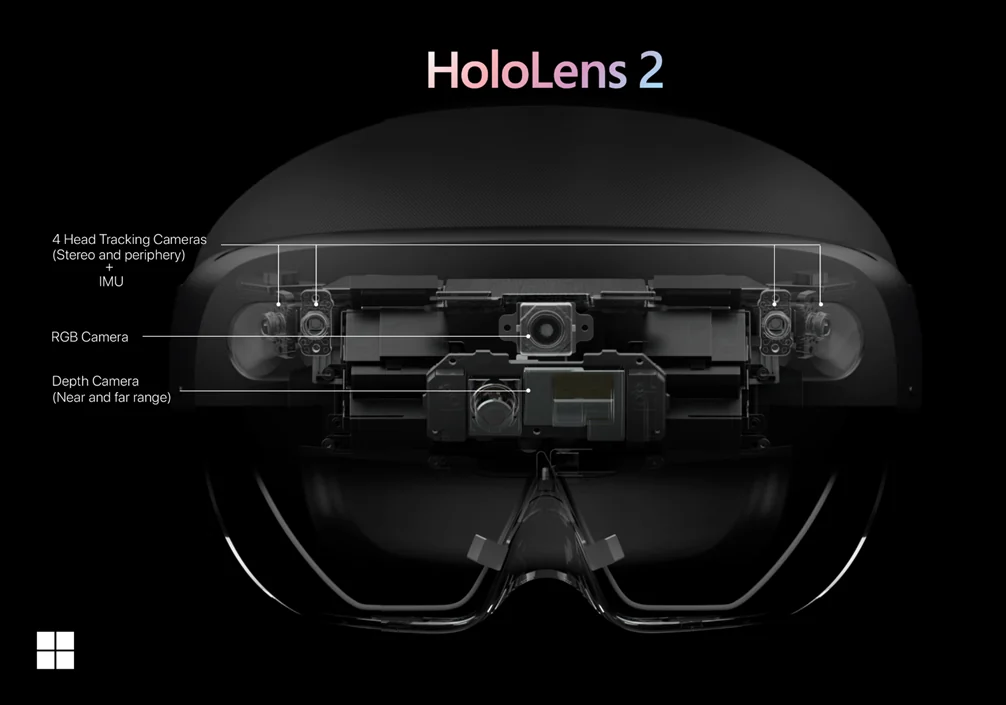
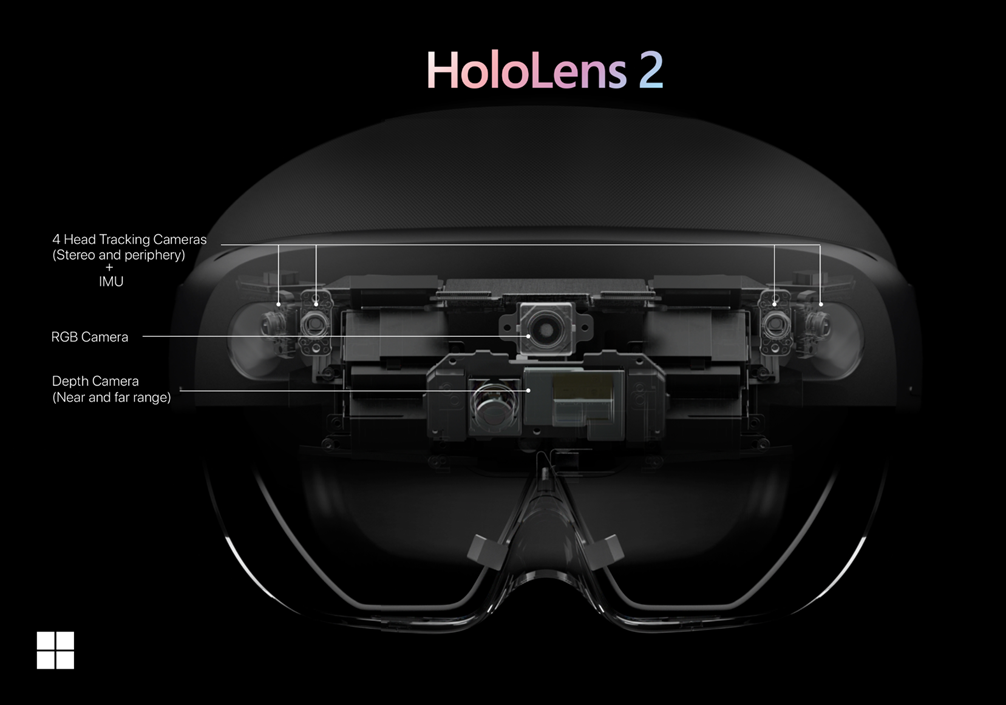
The mechanism is diffractive waveguide optics, not recorded interference. Microsoft's HoloLens 2 hardware specification page lists the optics as "See-through holographic lenses (waveguides)," paired with "2k 3:2 light engines" that project rendered imagery into those lenses. A waveguide is a thin sheet of glass or plastic carrying light from a small edge-mounted projector to a diffraction grating in front of the eye, redirecting it toward the wearer's pupil while still letting light from the real world pass through. The three-dimensional appearance comes from rendering a slightly different image per eye and updating it as the wearer's head moves, tracked by the onboard cameras the specification lists.
Viewing conditions and limits
The cited hardware page confirms the display sits inside the headset's own lenses, not projected into open space, and Microsoft's overview confirms the device is one of two headset categories precisely because it keeps the physical environment visible around the projected imagery. The image exists only for whoever wears that unit; a second HoloLens needs its own synchronized rendering to show a second wearer the same object, and a bystander with no headset sees an empty room. The cited documents describe no mode where the imagery is visible without the headset's own optics.
What it is not
This is not a free-space hologram, of the kind that projects a shared, headset-free image into a room for any bystander to see — the pattern covered elsewhere in this archive under Pepper's-ghost stage illusions and volumetric or light-field displays. Microsoft's naming choice, calling the see-through headset imagery a "hologram," describes a per-wearer optical trick inside a personal set of lenses, not a projection into the room itself. A promotional video showing several people apparently viewing the same floating hologram together shows what each wearer sees individually, not one shared image bystanders could photograph.
- Does seeing the "hologram" require putting on the specific headset, or could a bystander photograph it directly?
- Is the image visible from the same angle to two different people at once without each wearing a device?
- Does the product page describe waveguide or see-through headset optics, or a projector aimed at open air?
None of this makes HoloLens's imagery less real to its wearer — the headset genuinely renders a stable, head-tracked image anchored to the room. It means "hologram" here names a personal, waveguide-delivered illusion, not the shared, free-space image the word evokes in popular culture.
Sources & reading trail
Lists HoloLens 2's optics as 'See-through holographic lenses (waveguides),' confirming waveguide-based, per-headset display.
Source published: Not established · Retrieved: 16 September 2026
Defines holographic devices by a see-through display the wearer sees, distinct from a shared free-space image.
Source published: Not established · Retrieved: 16 September 2026
Papers, patents, vendor documentation and records establish the entry; the mechanism reading is Hologram Field Guide editorial analysis. This retrospective draft does not imply the site published on the event date.