What you see
On 21 January 2015, Microsoft used a Windows 10 media event to unveil HoloLens, a self-contained headset that its own launch-day site called part of “the world’s most advanced holographic computing platform.” That page promised a wearer would see “high-definition holograms” sitting inside an ordinary room — a 3D model pinned to a desk, a game character standing on the floor, a video call rendered as a floating window. None of it is visible to anyone else standing nearby. The imagery exists only on the inside of the visor’s two lenses, directly in the wearer’s line of sight, which is why the same page describes HoloLens as going ‘beyond a simple heads-up display’ while still keeping the room around it visible.
How it works
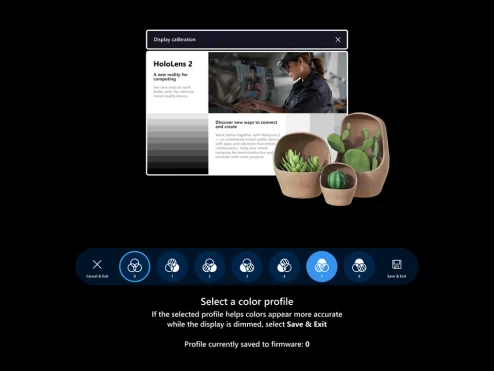
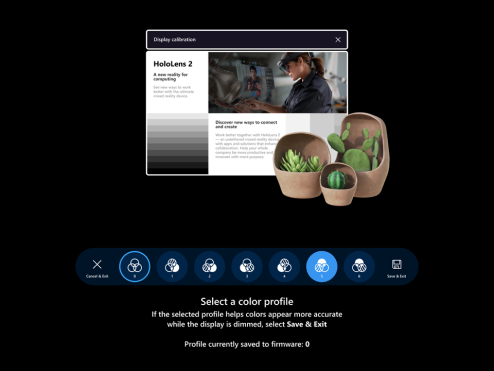
Microsoft’s later display support documentation states the mechanism plainly: the HoloLens 2 display is ‘a combination of waveguides and light projectors,’ with laser light illuminating an image that is steered into the eye through waveguides set into the visor’s lenses, rather than projected into open air. The same document says this optical approach carried over from the original 2015 headset, and Microsoft’s own hardware specification sheet lists the optics for the second-generation device as ‘see-through holographic lenses (waveguides),’ the manufacturer’s own term.
Viewing conditions and limits
Because the image is delivered inside the visor, only the wearer perceives it — a structural limit that a true free-space hologram would not share. Microsoft’s documentation is candid about the tradeoffs of that optical path: field of view, brightness and color uniformity are described as competing constraints of the waveguide hardware, and the company states it doubled the field of view’s area and made the light projectors up to three times brighter between the original HoloLens and HoloLens 2 — improvements bound by, in Microsoft’s own words, the existing technology, not eliminated by it. No document examined here gives an independent, non-manufacturer measurement of the 2015 headset’s field of view or brightness.
What it is not
HoloLens is not a free-space hologram of the kind produced by laser interference recording or a true volumetric display, where an image occupies real space and multiple unaided viewers can walk around it. Microsoft borrowed ‘holographic’ for the branding and for the imagery a wearer perceives, but its own technical documentation is explicit that the image is a waveguide-projected illusion visible to one headset at a time — a mixed-reality display, not an optically recorded or freely emitted hologram a room of bystanders could see unaided.
- Does viewing the content require a headset, and can anyone nearby see it without wearing one?
- Is a quoted field-of-view or brightness figure the manufacturer’s own spec, or independently measured?
- Has the optical mechanism been named specifically — waveguide, projector type — or only described as ‘holographic’?
HoloLens’s 2015 unveiling set a pattern that recurs across the AR headset category examined in this guide: a marketing vocabulary borrowed from optical holography, attached to a mechanism — waveguide combiner optics under a visor — that produces a private, headset-bound image rather than a hologram a room could see unaided.
Sources & reading trail
Microsoft's own launch-day marketing describes HoloLens as a holographic computing platform whose imagery blends with, but does not replace, the visible room.
Source published: Not established · Retrieved: 16 September 2026
States the display is a combination of waveguides and light projectors viewed through the visor, and that Microsoft doubled the field of view between generations.
Source published: Not established · Retrieved: 16 September 2026
Lists the HoloLens 2 optics as see-through holographic lenses (waveguides) in the manufacturer's own tech-spec sheet.
Source published: Not established · Retrieved: 16 September 2026
Papers, patents, vendor documentation and records establish the entry; the mechanism reading is Hologram Field Guide editorial analysis. This retrospective draft does not imply the site published on the event date.