What you see
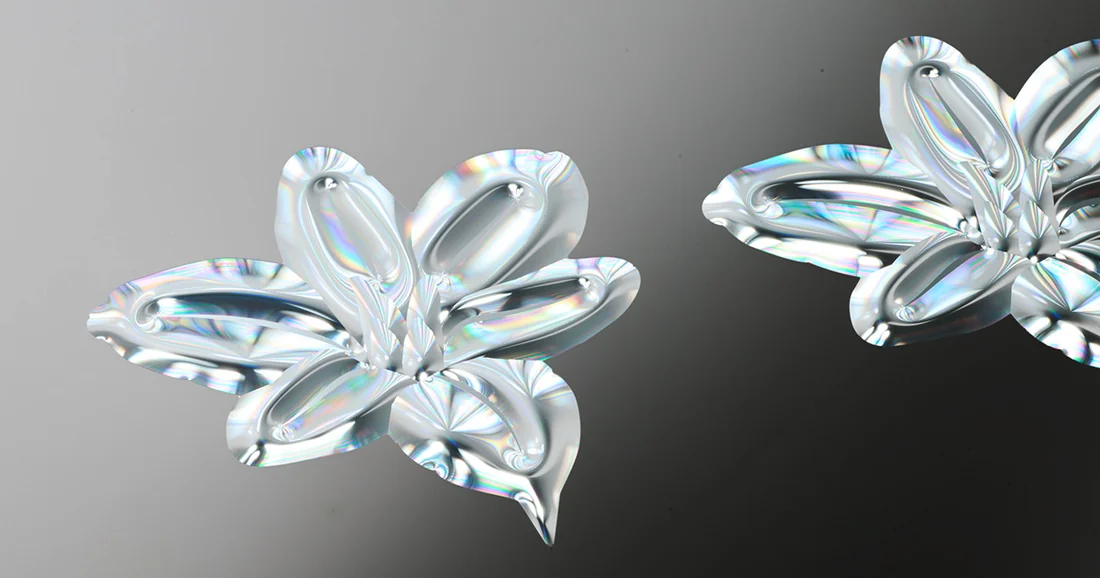
A shiny metallic patch on a passport page, an ID card, a banknote, or a product box shifts colour and motion as you tilt it under ordinary room light. No headset or special lamp is needed. The same patch appears, pixel for pixel, on every other card from the same production run, because it was not recorded from a unique scene each time.
How it works
A US patent for a holographic security label, assigned to Kaunas University of Technology, sets out the sequence: a diffractive pattern is originated once in a photoresist layer by electron-beam lithography combined with a dot-matrix technique, then a nickel layer is electroplated over it to grow a single metal master, or nickel shim, carrying the pattern as a physical relief. That one shim is then used, in the patent's own words, 'for roll-to-roll replication' to emboss the pattern into a polymer film many times over, after which the film is metallised and cut into finished labels.
Applying the finished foil to a product is a separate, later step. Leonhard Kurz, a foil manufacturer, describes on its own page two methods: hot stamping with presses such as its MM-6000 series, and a cold-transfer module called DISTORUN fitted to a flexo press. Kurz's public pages do not describe the earlier shim-making step in the patent's detail, unsurprising since that step is what counterfeiters most want to copy.
Viewing conditions and limits
Every source here agrees the viewing side needs only ordinary light and a tilt of the wrist; the security value sits upstream, in how hard the master is to reproduce, so it depends on controlling that one shim, not on any property of an individual card. Higher-security government devices separate themselves from this category: OVD Kinegram's own page states its KINEGRAM product is a proprietary device sold only to governments, unlike 'traditional, commercially available security holograms.'
What it is not
This is not a photograph of a real scene recorded by interference, as a museum transmission or reflection hologram is. The pattern was drawn or computed once, then copied mechanically like a stamped coin, not re-recorded per unit. A shifting foil patch is also not, by itself, proof of authenticity: the patent shows the identical structure can be replicated indefinitely from one shim, so a stolen master reproduces the same pattern.
- Was the pattern originated by electron-beam lithography, laser interferometry, or a dot-matrix technique?
- How is the nickel master shim controlled, and is it ever retired to limit how many copies trace back to it?
- Is the same foil design licensed to more than one customer, weakening what it can prove about any one document?
Embossed security holograms are not worthless; their value comes from controlling the master and supply chain, a manufacturing question rather than an optical one.
Sources & reading trail
US patent 11,846,888 (Kaunas University of Technology) describes electron-beam/dot-matrix origination, electroplated nickel master-shim production, and roll-to-roll embossing replication for holographic security labels.
Source published: 19 December 2023 · Retrieved: 16 September 2026
Kurz's own page describes hot stamping (MM-6000 series) and cold transfer (DISTORUN) as the methods used to apply finished hologram foil to labels, cards, and packaging.
Source published: Not established · Retrieved: 16 September 2026
OVD Kinegram's own page states that KINEGRAM is a proprietary government-only device distinct from traditional, commercially available security holograms.
Source published: Not established · Retrieved: 16 September 2026
Papers, patents, vendor documentation and records establish the entry; the mechanism reading is Hologram Field Guide editorial analysis. This retrospective draft does not imply the site published on the event date.