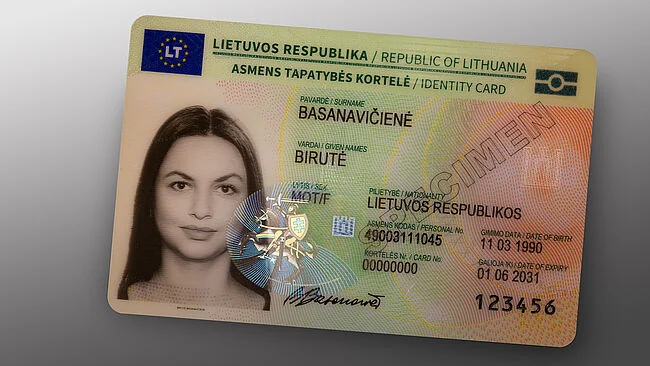
What you see
A KINEGRAM feature on a passport or ID card looks like a small, mirror-bright patch that shifts color and shows moving imagery as the document is tilted under light, often overlapping the photo. OVD Kinegram's own technologies page shows examples embedded directly over portraits on documents including a Canadian passport, a Bulgarian national ID card, and a Finnish passport, describing both fully transparent and partially metallized versions of the feature as currently produced.
How it works
OVD Kinegram's own secure DOVID explainer classifies the KINEGRAM as a 'Diffractive Optically Variable Image Device', built on 'the principle of diffraction', meaning microscopic structures on the foil bend light of different wavelengths in different directions so the color and image shift as the viewing angle changes. The same page states directly that 'unlike security holograms, KINEGRAM DOVIDs from OVD Kinegram are only available to governments,' describing the underlying manufacturing as 'non-holographic', with 'vector-based structures' the company says give it 'unlimited resolution', contrasted against what it calls a 'dot matrix passport hologram with resolution limitations.'
Viewing conditions and limits
The effect requires an external light source and a change in viewing angle to reveal its full color-shifting and movement effects; OVD Kinegram states the feature is designed for both fast human verification by eye and machine authentication by document readers or e-gates. The company's own page states the KINEGRAM has been used on identity documents since 1985 and is currently used by issuers in over 120 countries, without naming which specific national currencies, as opposed to ID documents, carry the feature.
What it is not
OVD Kinegram's own material draws an explicit line here: a KINEGRAM is a diffractive device, but the company states its own manufacturing process is 'non-holographic', distinguishing it from the embossed, dot-matrix security holograms used elsewhere in the document-security industry. Both fall under the broader category of diffractive optically variable devices, but calling every color-shifting security foil a 'hologram' obscures a real manufacturing difference that OVD Kinegram treats as central to its own security claims.
- Does the vendor call its own product a hologram, a DOVID, or a specific proprietary term?
- Is the feature verifiable by eye alone, or does it require a machine reader?
- Which specific document or currency is named as using this feature, rather than the technology being described only in general terms?
OVD Kinegram's own materials are unusually direct about a distinction the general public rarely makes: the diffraction-based color shift on an ID document may or may not be a hologram in the strict manufacturing sense, and the company stakes its own security claims on that difference.
Sources & reading trail
Shows named identity documents, including a Canadian passport and Finnish passport, carrying embedded KINEGRAM features, and describes metallized versus transparent variants.
Source published: Not established · Retrieved: 16 September 2026
States the KINEGRAM is a diffraction-based, non-holographic DOVID technology, distinguishes it from dot-matrix security holograms, and gives its 1985 first-use date and 120-country adoption figure.
Source published: Not established · Retrieved: 16 September 2026
Papers, patents, vendor documentation and records establish the entry; the mechanism reading is Hologram Field Guide editorial analysis. This retrospective draft does not imply the site published on the event date.