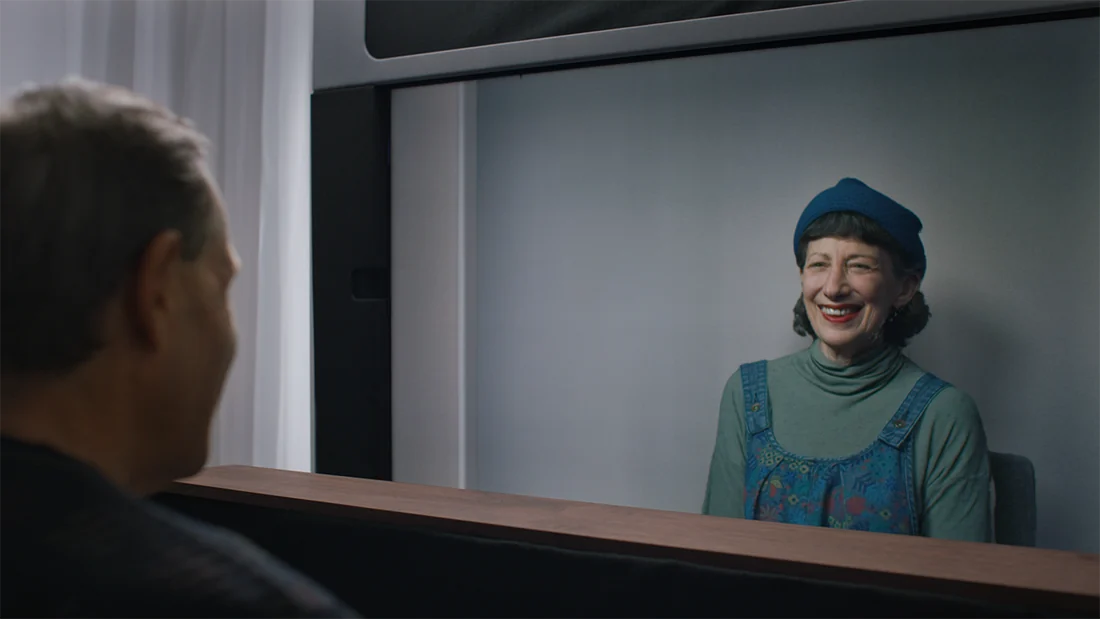
What you see
Sit across from someone using the system Google first called Project Starline and, per Google's own 2021 announcement, you look "through a sort of magic window" and see the other person "life-size and in three dimensions," making eye contact and natural gestures. No glasses or headset sit between the two participants; the effect depends on a purpose-built booth with its own display and camera array on each end of the call. Google's later rebrand, now called Beam, keeps the same promise: participants appear "life-sized and in 3D" so that "you can read a smile, catch a glance, and pick up on all the subtle cues that deepen communication."
How it works
The 2021 post attributes the effect to "computer vision, machine learning, spatial audio and real-time compression" feeding "a breakthrough light field display system that creates a sense of volume and depth." That names a light-field emission mechanism: depth-sensing cameras capture a subject from multiple angles, software reconstructs a three-dimensional model in real time, and the booth's display emits light rays calibrated so each eye sees a slightly different, correctly angled view, producing a solid three-dimensional presence rather than a flat video feed. The Beam page updates the description to "AI, 3D imaging, and light field rendering" but keeps light-field emission as the core mechanism.
Viewing conditions and limits
Both descriptions depend on dedicated hardware at both ends of a call, the 2021 post calls it "custom-built hardware and highly specialized equipment" available in only a few Google offices at the time, and the Beam page pairs the system with a device built with HP. Neither page states a numeric field of view, a maximum viewing distance, or how many people can sit at one booth, gaps in the public material as retrieved on 16 September 2026. Both agree no headset or glasses are needed, which Beam frames against "headsets or complex setup" as an alternative it avoids.
What it is not
Google's own language never calls this a hologram in either the 2021 announcement or the 2026 Beam page; both consistently use "3D video" and "3D imaging" instead. That word choice matters: the booth does not reconstruct a free-space image a bystander could walk around from outside its calibrated viewing zone, and it does not use interference-recorded holography. It is closer to a light-field-based telepresence display, a narrower claim than hologram, and Google's own material supports only the narrower one.
- What is the booth's actual field of view, and does the 3D effect hold if a viewer leans far to one side?
- How many locations or partners currently have working hardware, versus how many are only announced?
- Does the HP-built Beam device match the original Starline booth's capabilities, or is it a scaled-down commercial version?
The throughline from Starline to Beam is that Google has stayed consistent in what it calls the technology, even as the branding and hardware partner changed. That consistency is worth noting: a company describing a striking three-dimensional effect chose 3D video over hologram for years running, a useful data point about where the industry's own vocabulary draws the line.
Sources & reading trail
States the light-field display mechanism, capture technology and no-headset viewing condition, and avoids calling it a hologram.
Source published: 18 May 2021 · Retrieved: 16 September 2026
Shows the product's current rebrand and hardware partner, and confirms the same 3D-video terminology continues.
Source published: Not established · Retrieved: 16 September 2026
Papers, patents, vendor documentation and records establish the entry; the mechanism reading is Hologram Field Guide editorial analysis. This retrospective draft does not imply the site published on the event date.