What you see
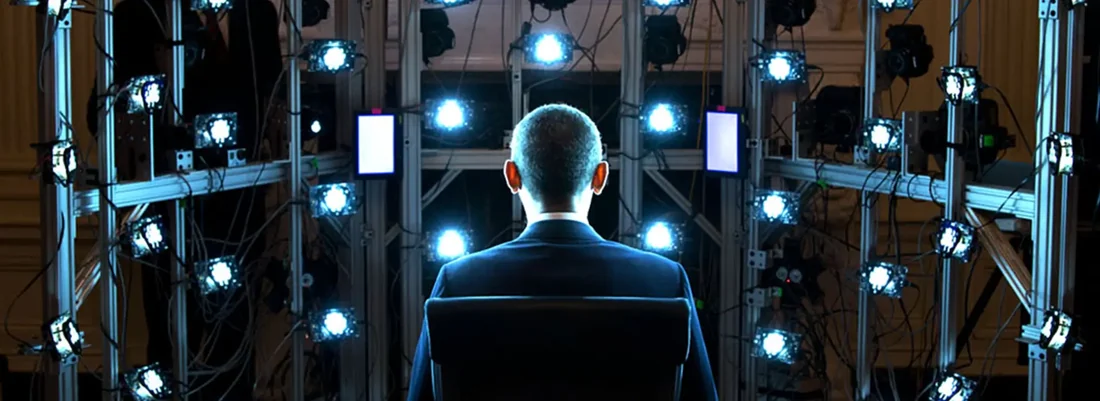
There is nothing to view in a Light Stage session itself; a subject sits inside a rig of lights while cameras record still images, and the result only becomes visible later as a computer-rendered image of a face on an ordinary 2D screen, relit under a lighting condition chosen after the fact. The original 2000 SIGGRAPH paper by Paul Debevec and colleagues describes synthetic renderings of a face under novel illumination and viewpoints, generated from the captured data, not a live optical effect a bystander could watch happen.
How it works
The paper describes a first-generation Light Stage as a two-axis rotation rig: an outer bar sweeps a directional light source around a vertical axis while an inner bar steps it through elevations, so the light source visits a dense set of directions around the subject's head. Video cameras record the face's appearance under each illumination direction, a process the paper says takes slightly over a minute. From those images the authors build a reflectance function for every visible facial pixel, describing how that point's brightness changes with light direction; combining these functions with a skin-reflectance model lets the system generate images of the face under new, computed lighting and, using estimated surface normals, under new viewpoints.
Viewing conditions and limits
None of this involves a viewer standing in front of anything in real time. The output is a set of rendered images or an animation, viewed the way any computer graphics render is viewed, on a screen, at whatever size and resolution the render was produced. USC's Institute for Creative Technologies, which now operates descendant Light Stage systems, states on its current Light Stage page, retrieved 16 September 2026, that the technology has contributed to production-quality digital assets in dozens of films and has received two Scientific and Technical Academy Awards, without describing any of it as a live display technology.
What it is not
A Light Stage is a capture and measurement rig, not a hologram, a light-field display, or any other viewer-facing device covered elsewhere in this guide. It records how a real face reflects light from many directions so that reflectance can be recomputed later under arbitrary lighting; nothing about the rig itself produces a three-dimensional image a person could look at directly. Confusing this with a display technology would mistake a data-acquisition method, closer in spirit to a scientific instrument, for something meant to be watched.
- Ask whether a claimed Light Stage result is a captured reflectance dataset or a finished rendered shot.
- Ask how many lighting directions and viewpoints were actually sampled during a given capture.
- Ask whether the relit face was rendered offline or is being shown as some kind of real-time display.
The distinction matters across this whole site: many of the volumetric and light-field technologies profiled here are display devices meant to be watched directly, while Light Stage is squarely on the other side of that line, an input method whose output is ordinary rendered imagery.
Sources & reading trail
Describes the two-axis rotating light-stage rig, capture time, reflectance-function construction, and rendering under novel lighting and viewpoint.
Source published: 1 July 2000 · Retrieved: 16 September 2026
Living-document confirmation that descendant Light Stage systems remain a capture technology for production assets, with Academy recognition.
Source published: Not established · Retrieved: 16 September 2026
Papers, patents, vendor documentation and records establish the entry; the mechanism reading is Hologram Field Guide editorial analysis. This retrospective draft does not imply the site published on the event date.