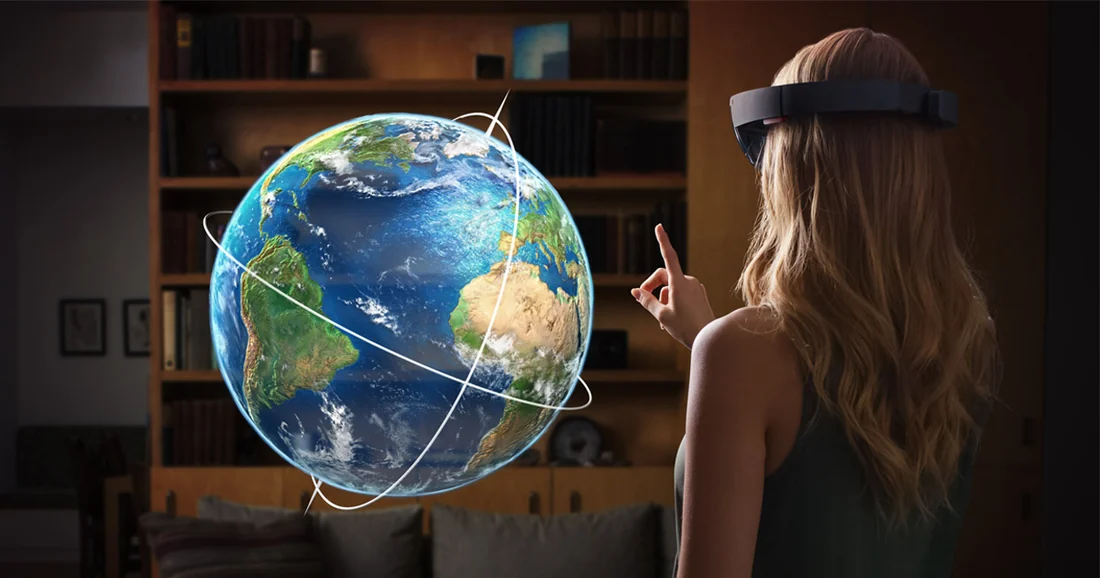
What you see
Nothing produced inside a Mixed Reality Capture Studio is visible on its own; the output is a file that must be played back through a headset, phone, tablet, or desktop app before anyone sees a moving 3D figure. Microsoft's own studio page says a viewer can then change their vantage point at any time or move around the recorded performance in a mixed-reality, VR, or 2D-screen app, seeing it from any angle the underlying capture supports.
How it works
Microsoft's page states the stage records performances using 106 cameras surrounding the subject, then applies computer-vision algorithms to build textured 3D surfaces, or meshes, of whatever is in view for every recorded frame. Further processing smooths the meshes over time and compresses the result, described as video holograms, for transmission; deliverables range from roughly 40,000 triangles with 2K texture for VR devices down to 10,000 triangles with 1K texture for mobile, exported as streamable compressed video or as raw mesh sequences with Unity and Unreal plugins provided for playback. A related Microsoft Research project, Holoportation, describes the same class of real-time 3D-from-cameras reconstruction feeding directly into a HoloLens or HTC Vive headset rather than being recorded for later editing.
Viewing conditions and limits
Microsoft's studio FAQ states the 106-camera rig generates about 10 gigabytes of raw data per second, that a standard shoot runs at 30 frames per second with 60fps possible, and that its Redmond stage is limited to three-to-four-minute takes while its San Francisco and partner facilities can record roughly an hour continuously. Studios operate in San Francisco, Redmond, and, through the partner Dimension Studios, London. None of this content is visible in open air; playback always requires a headset, screen, or mobile device, and image fidelity depends on the target device's processing budget, which the studio explicitly trades off in its polycount and texture options.
What it is not
Microsoft's own FAQ calls this output a video hologram or holographic video, but by its own description it is volumetric video: a time-varying 3D mesh derived from multi-camera photography, not an optically reconstructed wavefront and not visible without a display device. It is also not a live free-space image; a captured performance is edited, compressed, and delivered as an asset, then rendered by whatever headset or app plays it back, unlike Holoportation's real-time transmission use case.
- Ask whether a demonstrated hologram was captured and edited beforehand or transmitted live.
- Ask what headset, screen, or app was actually used to view the content, since none of it is visible unaided.
- Ask what polycount and texture resolution were delivered, since Microsoft's own range spans a wide quality gap.
Calling volumetric video a hologram is Microsoft's own consistent word choice across its documentation, but the mechanism it describes, camera-array capture converted to a played-back 3D mesh, is a different and more precisely definable thing.
Sources & reading trail
Microsoft's own FAQ describing the 106-camera rig, mesh pipeline, output specifications, take-length limits, and studio locations.
Source published: Not established · Retrieved: 16 September 2026
Documents the related real-time 3D-capture-and-transmission research feeding directly into headset playback, distinct from studio-based recording.
Source published: Not established · Retrieved: 16 September 2026
Papers, patents, vendor documentation and records establish the entry; the mechanism reading is Hologram Field Guide editorial analysis. This retrospective draft does not imply the site published on the event date.