What you see
InPhase Technologies never sold a data-storage disc you would recognize by looking at it as a hologram; the seeing here is a technical reading, not a viewing experience. The company's own "What is Holographic Storage?" document, copyrighted 2007 and preserved only through the Wayback Machine, describes a disc-shaped recording medium under a millimeter-scale photopolymer coating, branded Tapestry, that stores digital information as microscopic interference patterns throughout its full depth rather than on its surface. There is no display and no viewer; the record is read back electronically by a drive.
How it works
InPhase's "Technology Tour" document lays out the mechanism precisely: a single laser beam is split into a signal beam, encoded with a checkerboard pattern of over a million data bits by a spatial light modulator, and a reference beam; where the two beams intersect inside the photopolymer, they form a genuine optical interference pattern, a hologram in the classical sense, used to store data rather than reproduce a picture. Varying the reference beam's angle lets "hundreds of unique holograms" be recorded in the same volume, and reading data means shining the reference beam back through the medium so it diffracts off the stored pattern, reconstructing the full data page for a detector array to capture in one parallel readout.
Viewing conditions and limits
The Technology Tour document states demonstrated storage densities of "31.5 Gbits/in2," achieved by "recording and retrieving >3000 digital data pages" in laboratory materials, and separately claims newer photopolymer formulations had "the capability to store >100 Gbits/in2," a claim of capability, not a demonstrated shipping product. A Google Patents search for InPhase Technologies lists patents on holographic recording media and system architecture with priority dates from the early-to-mid 2000s, corroborating that a real, IP-protected engineering program stood behind the marketing documents. InPhase ceased operating around 2010, so none of these figures can be re-verified against a currently sold product.
What it is not
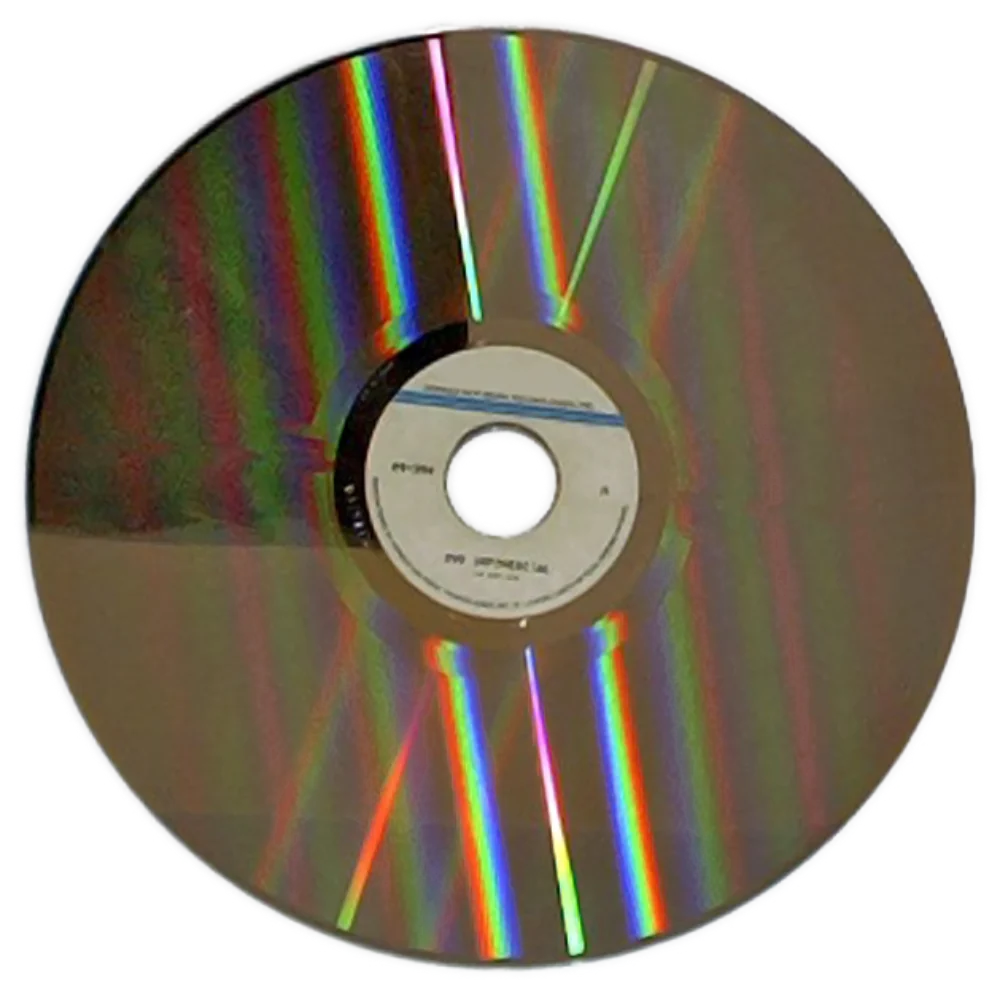
This is not a viewable hologram of the kind a museum or a stage show would display; the interference pattern is the storage mechanism, invisible to a human eye and meaningful only to the drive's optics and detector. It is also not the same technology as a laser optical disc such as a DVD, which stores bits as reflective pits on a surface read sequentially, rather than as volumetric interference pages read out in parallel.
- Did any Tapestry drive or disc actually reach commercial customers, or did the technology remain at demonstration and prototype stage?
- What became of InPhase's patent portfolio after the company stopped operating, and is any of it still active or licensed?
- Do the "capability to store" figures reflect a demonstrated recording, or a projection based on materials testing alone?
InPhase's own documents are candid about the physics: they call the recording mechanism a hologram because it genuinely is one, formed by real optical interference, and they distinguish between demonstrated densities and future capability claims. That the company no longer exists does not erase the physics; every figure here comes from an archived PDF rather than a live spec sheet.
Sources & reading trail
Describes the Tapestry photopolymer medium and the basic recording and reading process.
Source published: 1 January 2007 · Retrieved: 16 September 2026
Gives the detailed interference-recording mechanism and states specific demonstrated and target storage densities.
Source published: 1 January 2007 · Retrieved: 16 September 2026
Confirms a patent portfolio on holographic recording media and systems assigned to InPhase Technologies.
Source published: Not established · Retrieved: 16 September 2026
Papers, patents, vendor documentation and records establish the entry; the mechanism reading is Hologram Field Guide editorial analysis. This retrospective draft does not imply the site published on the event date.