What you see
A laser by itself produces no picture at all. A viewer of Theodore Maiman's original apparatus at Hughes Research Laboratories would have seen a small synthetic ruby rod inside a helical flashlamp, with the significant output being a narrow pulse of red light measured by a detector, not projected as any kind of image. Hughes' own successor laboratory, HRL Laboratories, records a telling detail about the announcement: the ruby rod and flashlamp shown in the widely published "first laser" photograph were larger than the ones in Maiman's actual working device, swapped in because the real hardware photographed too small, and other groups who tried to copy the picture initially used the wrong-sized lamp.
How it works
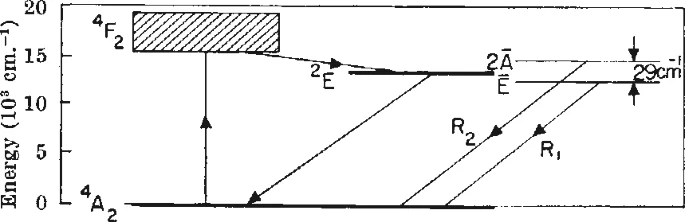
Maiman's own letter, "Stimulated Optical Radiation in Ruby," reports that "an optical pumping technique has been successfully applied to a fluorescent solid resulting in the attainment of negative temperatures and stimulated optical emission at a wave-length of 6943" angstroms, using ruby, chromium in corundum, as the active material. In plain terms: a bright flashlamp pumps chromium ions in the crystal into a population inversion, and light at that specific red wavelength is then amplified by stimulated emission as it bounces between mirrored ends of the rod, producing a coherent, narrow-band beam. This is a light-source technology, not an imaging or recording method.
Viewing conditions and limits
The property the Nature letter reports, a single, coherent wavelength, is exactly what an interference-based imaging method would later need, but the paper itself makes no claim about pictures, holography or three-dimensional reconstruction. HRL's own account frames the ruby laser's earliest practical application as range-finding, developed into what it calls "a multibillion-dollar laser range-finder business," not display or imaging.
What it is not
The ruby laser is not a holography method, and Maiman did not claim to have made one. Treating "the laser was invented" and "holography was invented" as the same event erases roughly two further years of separate work by other researchers, who combined this new coherent light source with an interference-recording technique Dennis Gabor had proposed twelve years earlier.
- Is the 1960 laser being credited with an imaging capability that Maiman's own paper never claims?
- Does a historical account distinguish the laser's invention from the holography demonstrations that later used it?
- Is a "first laser" photograph being treated as an accurate record of the device's actual size and construction?
Maiman supplied a light source with properties nobody had reliably produced before; what people did with that light source over the following two years is a separate, later story, and the two should not be told as if they happened in the same room on the same day.
Sources & reading trail
Maiman's own letter reporting stimulated optical emission at 6943 angstroms from chromium-doped corundum (ruby), the first published laser result.
Source published: 6 August 1960 · Retrieved: 16 September 2026
Hughes' own institutional history dates Maiman's public announcement to 7 July 1960 at New York's Hotel Delmonico and records that early publicity photos used a larger flashlamp and rod than the working device.
Source published: Not established · Retrieved: 16 September 2026
Papers, patents, vendor documentation and records establish the entry; the mechanism reading is Hologram Field Guide editorial analysis. This retrospective draft does not imply the site published on the event date.