What you see
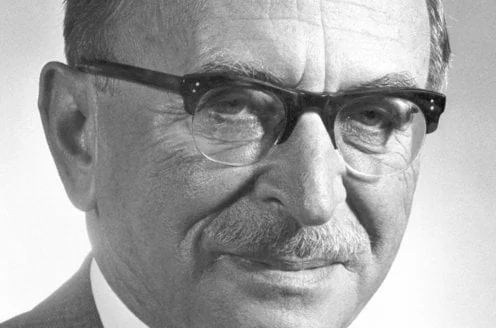
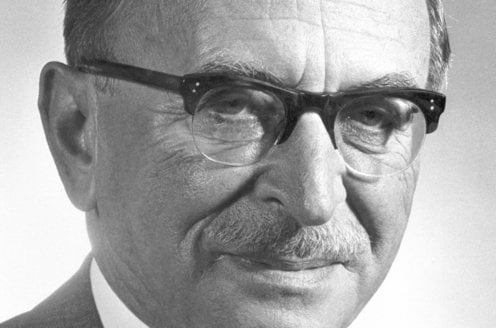
There is no finished hologram to look at from this paper. Dennis Gabor's letter in Nature, "A New Microscopic Principle", is a theoretical and experimental proposal, illustrated with the crude, doubled optical results Gabor could get from the partially coherent mercury-arc light available to him at the time. What a viewer would eventually see, once other researchers solved the problems this paper left open, is a reconstructed three-dimensional image visible by looking through an illuminated photographic plate. In 1948 itself, that image did not yet exist in a usable form.
How it works
The paper's own abstract, retrieved 16 September 2026, opens from a specific problem: "the spherical aberration of electron lenses sets a limit to the resolving power of electron microscopes at about 5 A," a limit so severe that correcting it directly seemed, in Gabor's words, "a practically hopeless task." His proposed way around it was a two-step method later called wavefront reconstruction: record the interference between a reference wave and a wave scattered by the object, then illuminate the developed record with a similar reference wave to regenerate the object's original wavefront, phase information included. Nature's own editorial note on the article confirms this is the principle "now known as holography."
Viewing conditions and limits
Gabor's own later account, given in his Nobel biographical statement, is blunt about what the 1948 method could not yet do. He calls the underlying experiments "wavefront reconstruction" and states that his light source produced only partial coherence, leaving an unwanted second, overlapping image he could not remove. A follow-on attempt to apply the idea to real electron microscopy, run from 1950 to 1953 with the AEI Research Laboratory, again fell short of the goal of resolving individual atoms. Gabor's own verdict: "we had started 20 years too early."
What it is not
The 1948 paper is not itself a working hologram in the sense of a clean, viewable three-dimensional reconstruction; it is a proposal tested only crudely with the light available at the time. It should not be credited with the laser-illuminated transmission holograms Emmett Leith and Juris Upatnieks demonstrated at the University of Michigan in the early 1960s, nor with Yuri Denisyuk's separate single-beam approach from the same period — both arrived more than a decade later and solved problems this paper left unsolved.
- Does a "since 1948" claim describe Gabor's original electron-microscope proposal, or the later laser-based method that made holography practical?
- Is the unremoved twin image Gabor's own account describes mentioned at all, or is the 1948 result presented as already complete?
- Is a claimed hologram viewable without the kind of coherent illumination the original method needed?
The gap between Gabor's proposal and a hologram someone could actually look at is itself instructive: an idea and a working demonstration are not the same claim, and the twenty-three years between this paper and Gabor's Nobel Prize were filled largely by other people's engineering.
Sources & reading trail
The paper's own abstract on the electron-microscope resolution problem, and Nature's editorial annotation identifying the paper as the origin of wavefront-reconstruction holography.
Source published: 1 May 1948 · Retrieved: 16 September 2026
Gabor's own first-person account that the 1948 work targeted electron-microscope resolution, used the term wavefront reconstruction, and needed the laser that arrived only later.
Source published: Not established · Retrieved: 16 September 2026
Papers, patents, vendor documentation and records establish the entry; the mechanism reading is Hologram Field Guide editorial analysis. This retrospective draft does not imply the site published on the event date.