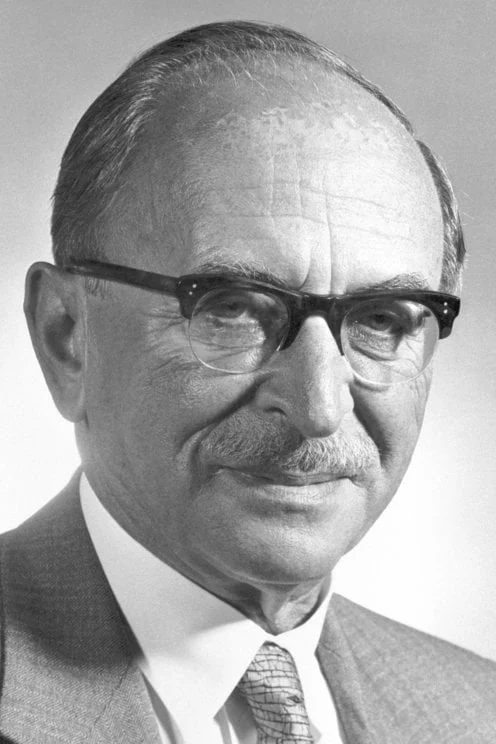
What you see
There is no apparatus to view here; the event is a citation announced and a speech read aloud in Stockholm. The Nobel Prize summary records only the award itself: the 1971 Nobel Prize in Physics went to Dennis Gabor "for his invention and development of the holographic method." What the ceremony audience actually saw, per the Academy's own account, was an explanation delivered with photographic-plate and electron-microscope examples, not a live hologram demonstration.
How it works
The citation itself recognizes "invention and development of the holographic method" broadly rather than any single named optical result. The Academy's own award ceremony speech, delivered by professor Erik Ingelstam, traces how an ordinary photograph loses the phase information needed for three-dimensional detail, explains how Gabor's approach recovers it, and states that his 1948 to 1951 papers "attained an exact analysis of the method" whose equations "even today, contain all the necessary information." The same speech then credits the practical breakthrough to two later, separate developments: the first laser, built in 1960, and a fix for "disturbing double images," which the speech attributes to "a research group at Michigan University in the United States, led by Emmett Leith."
Viewing conditions and limits
The prize citation sets no viewing conditions of its own since it is a written statement rather than an experiment, but the ceremony speech is explicit that the visible three-dimensional experience the audience associated with holography by 1971 depended on tools Gabor did not have when he wrote his defining papers, chiefly "the laser as a light source."
What it is not
The 1971 award is not evidence that Gabor personally built the laser-illuminated transmission holograms most associated with the word today; it is not a joint prize shared with Leith, Upatnieks or Denisyuk, whose engineering the ceremony speech names as the missing pieces; and it should not be dated to 1948, even though the invention it honours originates there. Twenty-three years separate the paper from the prize.
- Does an account credit Gabor with the principle, or also with building a demonstrable, viewable hologram?
- Is Gabor's 1971 Nobel Prize misdated to 1948, the year of his original paper?
- Are the later researchers whose work the Nobel ceremony speech itself names still credited, or quietly dropped from the story?
A Nobel Prize can honour an idea's long-term significance without meaning the laureate finished the engineering alone; the Academy's own ceremony speech says so explicitly about Gabor, crediting the laser and the Michigan group's fix as the steps that turned his papers into something the world could actually see.
Sources & reading trail
States the exact citation: the 1971 Nobel Prize in Physics was awarded to Dennis Gabor for his invention and development of the holographic method.
Source published: Not established · Retrieved: 16 September 2026
The Academy's own presentation speech explains that Gabor's 1948-1951 papers were realized in practice only once the 1960 laser existed and a Michigan group led by Emmett Leith solved the twin-image problem.
Source published: Not established · Retrieved: 16 September 2026
Papers, patents, vendor documentation and records establish the entry; the mechanism reading is Hologram Field Guide editorial analysis. This retrospective draft does not imply the site published on the event date.