What you see
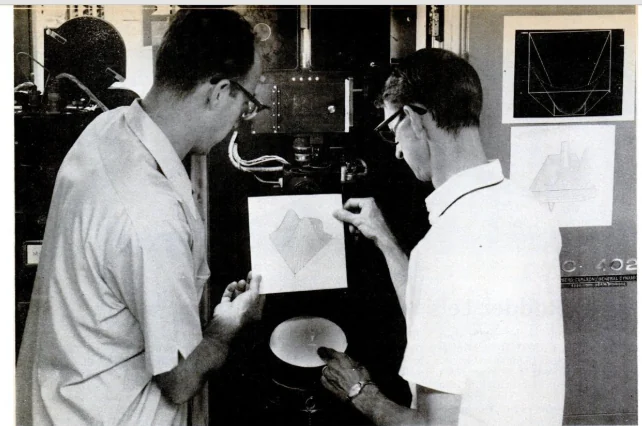
Nobody looks at a live scene here. The object of attention is a physical artifact: a large-scale line drawing made by an automatic plotter, photographically reduced to a small transmissive plate, then illuminated with coherent light so a viewer can see a reconstructed image. The 1967 abstract for Adolph Lohmann and Byron Paris' paper describes that chain: an object that exists only “in mathematical terms” is turned into a plotted pattern, reduced photographically, and only then does a viewer see anything, standing where the reconstructed wavefront can be intercepted, much as one views an ordinary transmission hologram. No headset, screen, or live subject was involved in making the image; the object being reconstructed never existed physically.
How it works
The abstract states the method plainly: because a hologram can be computed from a mathematically defined object, the resulting pattern can be drawn by machine rather than recorded from real interfering light. The catch is that a plotter's output is necessarily two-valued — it “can contain only black and white areas” — so an ordinary continuous-tone hologram cannot simply be plotted. Lohmann and Paris developed a theory for these binary holograms and showed, in theory and experiment, that a binary pattern can reconstruct an image equivalent to an ordinary photographically recorded hologram. That is the actual claim, per the paper's own indexed publication record: a way to encode a computed wavefront into a two-level pattern a pen plotter can draw, not a specific optical layout.
Viewing conditions and limits
The retrieved abstract gives no viewing angle, image size, brightness, or count of simultaneous viewers, and none should be assumed. It does establish a process with several lossy steps between a mathematical object and a viewable image: computation, large-scale plotting, and photographic reduction, each bounding the final resolution. The abstract's own hedge is instructive — the equivalence to an ordinary hologram is something the authors say they “proven theoretically and verified experimentally,” a bounded claim about reconstruction fidelity, not one about brightness, size, or comfort.
What it is not
This is not a real-time or electronic computer-generated hologram in the sense used by later spatial-light-modulator displays. There is no display hardware at all: the output is a static, printed transparency, reconstructed once, not refreshed or interactively rendered. Conflating this 1967 result with a modern real-time CGH system, such as later GPU-driven holographic near-eye prototypes, credits it with capabilities — live update, electronic modulation — the abstract does not claim and the plot-and-reduce process could not deliver.
- Is the hologram being described a static, printed pattern or a dynamically updated electronic display?
- What steps sit between the computed pattern and the viewable image, and what does each cost in resolution?
- Does the source claim a theoretical equivalence to ordinary holograms, or a specific measured image quality?
The paper's contribution is narrow but foundational: proof that a hologram need not be recorded from real interfering light, provided the resulting pattern can still be printed and read back optically. Later computer-generated holography, including the electronically modulated displays described elsewhere in this archive, inherits that basic move without inheriting this paper's plot-and-reduce mechanics.
Sources & reading trail
Gives the paper's own abstract: a computed hologram plotted at large scale, photographically reduced, restricted to black-and-white areas, and shown theoretically and experimentally equivalent to an ordinary hologram in reconstruction.
Source published: 1 October 1967 · Retrieved: 16 September 2026
Confirms authors A. W. Lohmann and D. P. Paris, journal Applied Optics volume 6 issue 10 page 1739, and the October 1967 publication date.
Source published: 1 October 1967 · Retrieved: 16 September 2026
Papers, patents, vendor documentation and records establish the entry; the mechanism reading is Hologram Field Guide editorial analysis. This retrospective draft does not imply the site published on the event date.