What you see
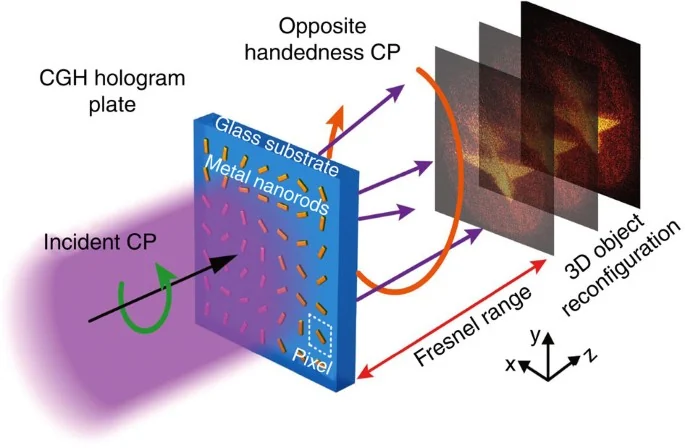
The subject of this entry is not a display you can walk up to; it is a laboratory result described in a peer-reviewed paper. "Three-dimensional optical holography using a plasmonic metasurface," published in Nature Communications on 15 November 2013 by Lingling Huang, Xianzhong Chen, Holger Mühlenbernd and co-authors across the University of Birmingham, the University of Paderborn and Tsinghua University, reports a reconstructed three-dimensional image built from a flat, sub-wavelength patterned surface rather than a thick recording medium or a bulky lens system. Illuminating the metasurface with the correct light reconstructs a three-dimensional scene photographable from different focal planes, demonstrating genuine depth rather than a flat picture.
How it works
The paper's own abstract describes a metasurface built from "subwavelength metallic nanorods with spatially varying orientations," each nanorod acting as a tiny antenna that shifts the phase of light passing through it. Reversing the handedness of circularly polarized light reverses that phase shift, letting the same structure be programmed, through nanorod orientation alone, to reconstruct a chosen three-dimensional wavefront, the paper describes this as achieving "high-resolution on-axis three-dimensional holograms with a wide field of view" while suppressing the extra, unwanted duplicate images that plague older holographic-optics designs. This is computational, structure-based holography: the recording is a lithographically patterned nanostructure, not a photochemical interference pattern captured from a real scene.
Viewing conditions and limits
As a laboratory device, this metasurface has no consumer viewing conditions to report, no headset, no glasses, no minimum room brightness. The abstract makes no numeric efficiency or brightness claim, and no percentage figure for diffraction efficiency appears in the material reviewed for this entry. Any specific efficiency number attached to this work elsewhere should be checked against the paper's full methods directly, not assumed from the abstract. Nature Communications itself is a peer-reviewed, open-access journal, a different credibility marker than a company's own product page.
What it is not
This is not a viewable consumer display and is not directly comparable to a fan-rotor or light-field product; it is closer in spirit to the original laser-based transmission holograms of the 1960s in that it reconstructs a genuine three-dimensional wavefront, but it replaces the photographic recording medium with an engineered nanostructure. It should not be described as a holographic display in the commercial sense, since nothing in the paper describes a real-time, updatable image.
- Does the full paper, beyond the abstract, report a specific diffraction or reconstruction efficiency, and under what wavelength and polarization?
- Is the demonstrated three-dimensional image static, fixed at fabrication, or can the metasurface be reconfigured after manufacture?
- Has this plasmonic approach been superseded by later dielectric metasurface designs reporting higher efficiency?
The 2013 paper is a good marker for how hologram survives as a precise term even in advanced photonics research: the authors use it because the device reconstructs a three-dimensional wavefront by controlled interference of light, the same physics Gabor described, implemented in a flat nanostructure instead of photographic film. That precision is worth preserving whenever the word gets stretched to cover a rotating fan or a glass-and-video retail case.
Sources & reading trail
Gives the paper's mechanism, authors, affiliations, publication date and confirms no efficiency percentage is stated in the abstract.
Source published: 15 November 2013 · Retrieved: 16 September 2026
Establishes the journal's peer-reviewed, open-access, multidisciplinary scope.
Source published: Not established · Retrieved: 16 September 2026
Papers, patents, vendor documentation and records establish the entry; the mechanism reading is Hologram Field Guide editorial analysis. This retrospective draft does not imply the site published on the event date.