What you see
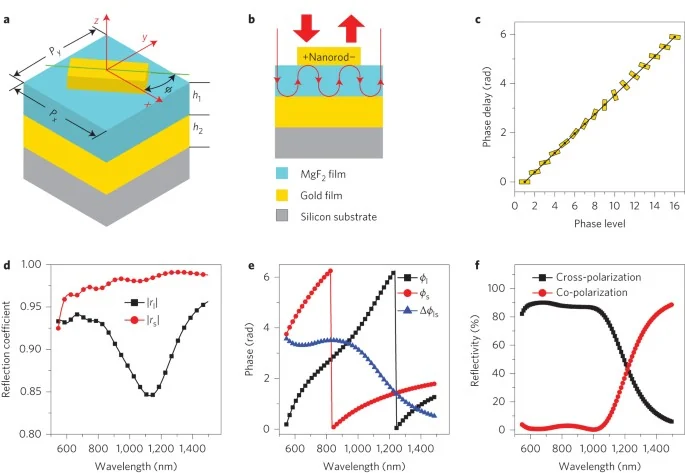
The paper describes a reconstructed image formed by shining light on an ultrathin, nanostructured surface, read out optically rather than through any headset or screen. Its abstract, retrieved directly from Nature Nanotechnology, states the design reaches “diffraction efficiencies of 80% at 825 nm and a broad bandwidth between 630 nm and 1,050 nm,” meaning a viewer or detector positioned to catch the diffracted beam sees most of the incident light redirected into the intended image rather than scattered or absorbed, across a range spanning red to near-infrared light, not a single narrow color.
How it works
Titled “Metasurface holograms reaching 80% efficiency,” and published February 23, 2015 by Guoxing Zheng, Holger Mühlenbernd, Mitchell Kenney, Guixin Li, Thomas Zentgraf, and Shuang Zhang, the paper's own abstract describes a “16-level-phase computer-generated hologram” built from a “geometric metasurface” — an array of plasmonic nanorods with spatially varying orientation that controls the phase of reflected light through its geometry rather than through material thickness. The design integrates this metasurface with a ground metal plane, forming a reflectarray that the abstract says improves polarization conversion efficiency without adding fabrication complexity. This is metasurface-based computer-generated holography: a computed phase pattern etched into a nanostructured reflective surface, distinct from an interference-recorded hologram and from the fan-shaped rotating-LED illusions covered elsewhere in this archive.
Viewing conditions and limits
The 80% efficiency and the 630–1,050 nm bandwidth are the paper's own reported laboratory results for its specific fabricated sample, not a general property of all metasurface holograms; the abstract does not state image size, viewing angle, or how the device would perform outside the described experimental setup. Because the abstract is a preview of the full paper, additional method-specific limits, such as fabrication tolerances or sample size, sit in sections this entry did not open and are not asserted here.
What it is not
This is not the same paper as the 2013 Nature Communications metasurface hologram work covered elsewhere in this archive, a distinction an independent bibliographic record for this 2015 paper helps keep straight; the two reports are separate publications, roughly two years apart, describing related but distinct metasurface hologram designs, and citing one for the other's reported efficiency figure would misattribute the result. It is also not a display product: the paper reports a fabricated sample's measured optical performance in a research setting, not a manufactured screen or headset component ready for integration.
- Is a cited efficiency or bandwidth figure attributed to this 2015 paper, the earlier 2013 paper, or a later metasurface study entirely?
- Was the reported efficiency measured at the single wavelength stated, or across the full claimed bandwidth?
- Does the source describe a fabricated, measured sample or a simulated design only?
Read narrowly, the paper's contribution is a specific, dated efficiency and bandwidth result for one geometric-metasurface hologram design, useful for tracking how quickly metasurface holography's measured performance improved, not a general verdict on the technology's readiness for display products.
Sources & reading trail
Publisher's own abstract giving the reported 80% diffraction efficiency at 825nm, the 630-1,050nm bandwidth, the 16-level-phase geometric-metasurface method, authors, and publication date.
Source published: 23 February 2015 · Retrieved: 16 September 2026
Independently corroborates the author list, journal, year, and DOI, and matches the abstract text against the publisher's page.
Source published: Not established · Retrieved: 16 September 2026
Papers, patents, vendor documentation and records establish the entry; the mechanism reading is Hologram Field Guide editorial analysis. This retrospective draft does not imply the site published on the event date.