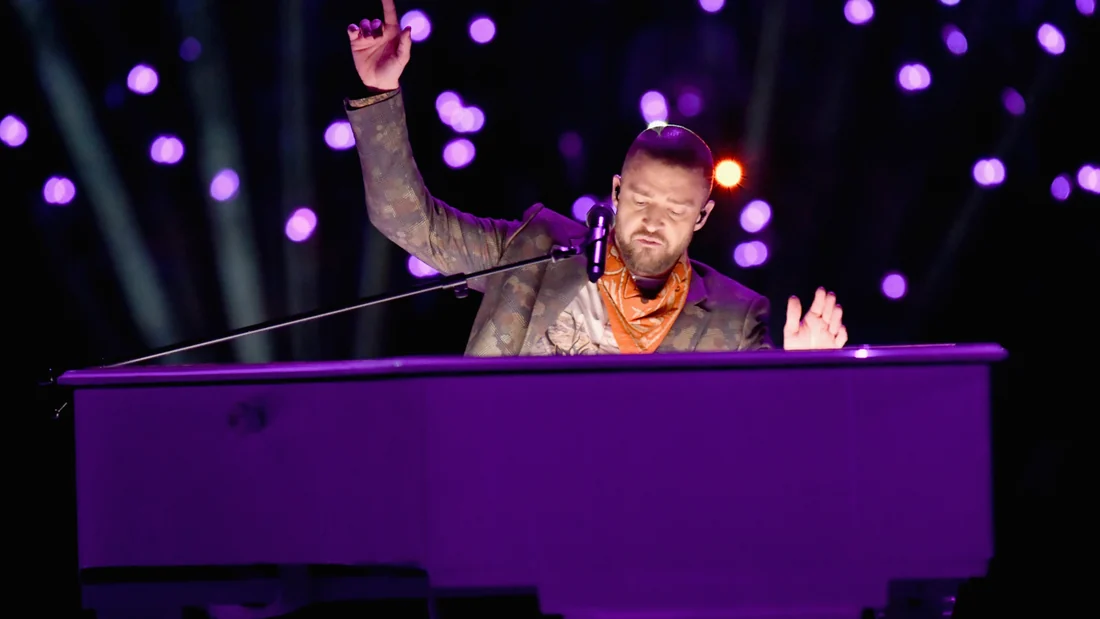
What you see
During Super Bowl LII's halftime show on 4 February 2018, Justin Timberlake sang Prince's I Would Die 4 U in Minneapolis while a large video image of Prince played behind him, described by Rolling Stone's contemporaneous report as a projection of Prince used as a pseudo-duet. No 3D glasses were issued and nothing appeared to float in open air; viewers at home and in the stadium saw a flat, screen-sized image of archival footage timed to Timberlake's live vocal.
How it works
The segment's creative visual lead, Nick Whitehouse of the effects company Fireplay, told Rolling Stone the team decided that the only person who could do Prince justice was Prince himself, meaning archival video, not a live performer, was projected onto a large screen behind Timberlake. TMZ's follow-up reporting, citing Prince collaborator Sheila E., frames the choice specifically as a projection of Prince versus a hologram, distinguishing the two on the record. This is a conventional large-format video projection married to a live vocal performance, not any interference-recorded or volumetric image.
Viewing conditions and limits
The Daily Beast's reporting from the day of the show establishes that Prince's family had previously objected to a hologram version of the late artist, which representatives had denied approval for. Prince's half-brother Omarr Baker, who had earlier said the family denied a hologram request, responded to the broadcast on social media with the dictionary definition of hologram alongside a thumbs-up for Timberlake, signaling the aired segment was not what the family had objected to. Prince himself, in a 1998 interview cited by the same report, had called a hologram of another artist the most demonic thing imaginable, context for why the distinction mattered.
What it is not
This was not a hologram in any optical sense: there was no coherent-light interference pattern and no image occupying three-dimensional space independent of the flat screen it aired on. It is also not the technique used in staged Pepper's-ghost hologram concerts, which project onto angled glass or foil to create an apparent floating figure; the segment used a conventional projection screen, without an angled-surface illusion. Sheila E.'s comment that a bigger company, not Timberlake, pushed for a hologram concept in early planning shows the word was in circulation before the simpler execution was chosen.
- Which company or vendor supplied the projection screen and video system used behind Timberlake, beyond the general Fireplay creative credit?
- Did any outlet obtain the family's full statement on what specifically they had objected to versus approved?
- How does this technique compare, mechanically, to touring hologram shows for other deceased performers marketed under that label around the same period?
Multiple contemporaneous reports agree on the same basic fact: what aired was archival video projected onto a screen, not a hologram, and the estate's objection had specifically targeted the hologram framing before the show settled on projection, a clean example of how a planned idea and an aired result can differ.
Sources & reading trail
Contemporaneous report describing the Prince segment as a projection and quoting the show's creative visual lead.
Source published: 5 February 2018 · Retrieved: 16 September 2026
Reports the family's prior objection to a hologram, the half-brother's public reaction, and Prince's own 1998 statement on holograms.
Source published: 4 February 2018 · Retrieved: 16 September 2026
Sheila E.'s on-record distinction between a projection of Prince and a hologram, and her account of where the hologram idea originated.
Source published: 10 February 2018 · Retrieved: 16 September 2026
Papers, patents, vendor documentation and records establish the entry; the mechanism reading is Hologram Field Guide editorial analysis. This retrospective draft does not imply the site published on the event date.