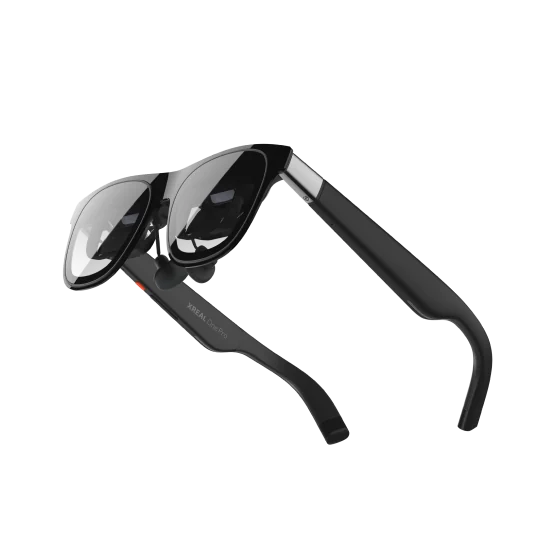
What you see
Xreal, the company formerly known as Nreal, sells consumer AR glasses meant to project a large virtual screen in front of the wearer for video and simple overlays. Its own product page for the One Pro describes the experience as showing ‘up to a 171 inch screen’ equivalent ‘at 4 meters.’ A wearer sees this virtual display composited over their surroundings; a bystander sees only a pair of dark-lensed glasses with nothing projected outward for them to view.
How it works
Xreal’s own product page names the optical combiner ‘X Prism,’ describing it as ‘Redefining AR optics with industry-first Innovation’ and stating the result is a ’57° FOV, NO stray light, NO reflections’ for the One Pro. The company’s main site lists the same X Prism combiner on its newer Aura glasses at a wider ‘70° FOV’ paired with a ‘Sony Micro-OLED, 1920 x 1200 pixels per eye’ panel, and describes one of that device’s modes plainly as ‘a private screen.’ Both pages name the combiner as a branded prism system, not a diffractive waveguide, with processing on the One Pro running through what its page calls the ‘XREAL X1’ spatial computing chip at up to 120Hz.
Viewing conditions and limits
The company states its own field-of-view figure as 57 degrees and describes the screen-size equivalence only ‘at 4 meters,’ meaning the perceived size changes with how far the wearer is from whatever they are viewing through the glasses. The claims of ‘NO stray light, NO reflections’ are the manufacturer’s own description of its X Prism combiner, not an independently measured optical result. No document examined here states that the projected image is visible to, or shareable with, anyone other than the wearer.
What it is not
Xreal’s own material never calls its glasses a hologram, and the mechanism it names — a branded X Prism combiner paired with a Micro-OLED microdisplay — is a private, screen-replacement display for one wearer, not a diffractive waveguide of the kind Snap or Microsoft name for their own headsets, and not a free-space or light-field image a room of people could see without glasses of their own.
- Does the manufacturer name its combiner as a waveguide, a prism, or another specific mechanism, rather than a generic 'AR optics' claim?
- Is a stated field-of-view or 'inch-equivalent screen' figure tied to a specific viewing distance, as Xreal states for 4 meters?
- Does any material describe the display as visible to bystanders, or is it, like Xreal's own description, private to the wearer?
Xreal’s consumer glasses show a company naming its own optical combiner precisely — X Prism, not waveguide — a distinction worth preserving given how loosely 'AR optics' and 'holographic' are used across this category.
Sources & reading trail
The company's own description of the X Prism combiner, 57-degree field of view, Sony Micro-OLED display, and the 171-inch screen equivalence at 4 meters.
Source published: Not established · Retrieved: 16 September 2026
Lists the X Prism combiner and a 70-degree field of view on the company's Aura glasses, and describes one device mode as 'a private screen'.
Source published: Not established · Retrieved: 16 September 2026
Papers, patents, vendor documentation and records establish the entry; the mechanism reading is Hologram Field Guide editorial analysis. This retrospective draft does not imply the site published on the event date.