What you see
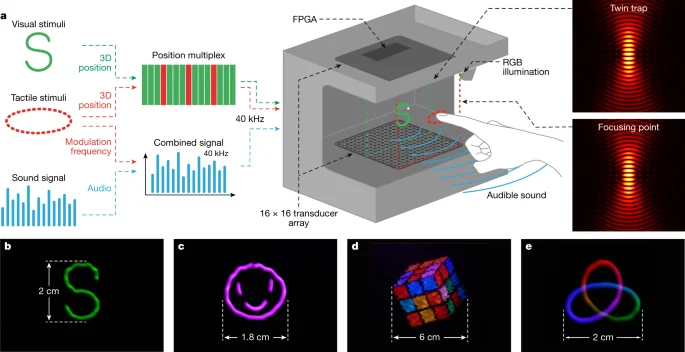
Inside a small chamber ringed with ultrasound speakers, a single glowing coloured dot races around fast enough to trace a simple shape hanging in mid-air, visible with the naked eye, no headset or screen involved. Phys.org's report on the work, published the same week as the paper, describes the team demonstrating shapes including a butterfly, a globe, and an emoji-like face, and states a viewer can reach in and feel the image, not only see it.
How it works
The device's own Nature paper, by researchers at the University of Sussex and Tokyo University of Science, names it the multimodal acoustic trap display (MATD) and states it uses 'acoustophoresis' as its 'single operating principle': banks of ultrasound transducers trap a small particle in mid-air with sound pressure alone, then steer that trap quickly enough that the single point, lit red, green, and blue to control colour, is read by the eye as a continuous shape, the abstract's own words, rather than one moving dot.
Touch and sound come from the same trap. Phys.org quotes researcher Ryuji Hirayama describing the tactile sensation as feeling 'like a gently spraying your hand with pressurised air,' produced by focused ultrasound energy alongside the visual trap, delivered, per the paper's abstract, using 'time multiplexing with a secondary trap.'
Viewing conditions and limits
The paper's own abstract states the particle reaches speeds 'of up to 8.75 metres per second' vertically and '3.75 metres per second' horizontally, a hard limit on how large or fast an image can be traced before the single-point illusion breaks down. The demonstrated system is a benchtop laboratory prototype with one point in flight at a time; these sources do not describe a system rendering scenes larger or more detailed than the simple shapes shown here.
What it is not
This is not an interference-recorded or light-field hologram, and nothing is projected onto a surface. A real, physical particle is moved through space by sound pressure, not an image formed by light alone, which is what lets the same mechanism also be felt and heard, unlike any purely optical display in this guide.
- How large a volume and how many points can the system sustain at once, since the reported speeds set the upper bound on image size?
- Do 'touch and see' claims for this kind of device cover the tactile and audio channels or the visual trace only?
- Is a given demonstration the benchtop research prototype described in the paper, or a later, different engineering version?
A single trapped, moving particle, not light alone, is what lets this display be seen, heard, and felt, a genuinely different mechanism from every optical hologram or projection described elsewhere in this guide.
Sources & reading trail
The paper's own abstract names the multimodal acoustic trap display, describes acoustophoresis as its single operating principle, and states the demonstrated particle speeds and multimodal (visual, tactile, audio) delivery method.
Source published: 13 November 2019 · Retrieved: 16 September 2026
Contemporaneous report quoting researcher Ryuji Hirayama on the tactile sensation and describing example shapes (butterfly, globe, emoji) the system rendered.
Source published: 14 November 2019 · Retrieved: 16 September 2026
Papers, patents, vendor documentation and records establish the entry; the mechanism reading is Hologram Field Guide editorial analysis. This retrospective draft does not imply the site published on the event date.