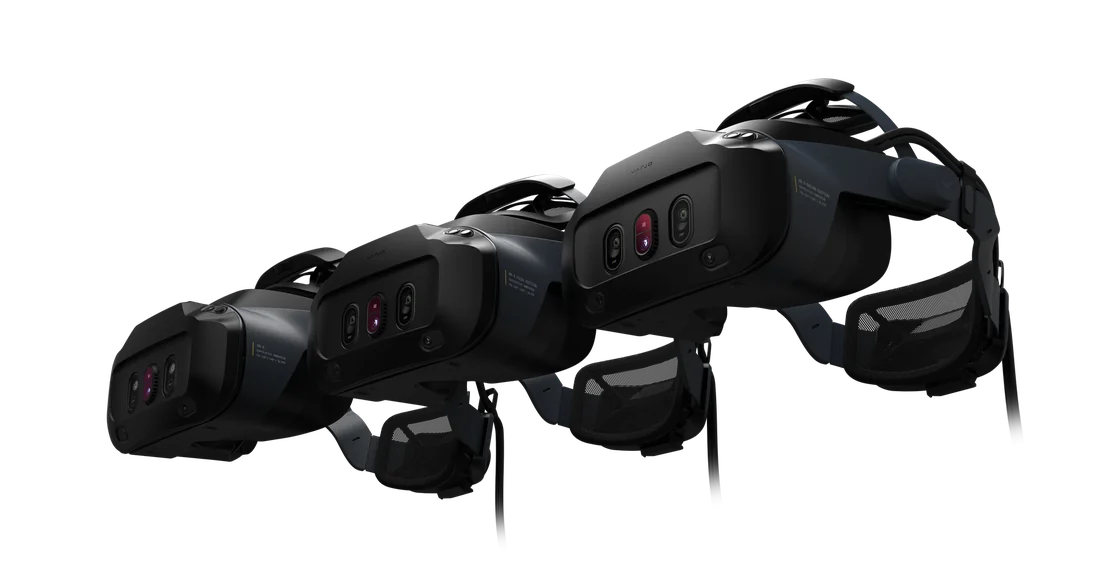
What you see
A Varjo XR-3 wearer sees no direct view of the outside world at all: two small cameras on the front of the headset stream live video to internal displays, and the wearer looks at that video feed rather than through any lens to reality. When a virtual object is added, it is composited into the video stream before it reaches the eye. Varjo's own archived XR-3 product page states the headset delivers 'photorealistic, true-to-life mixed reality powered by low-latency, 12-megapixel video pass-through', not an optical see-through window.
How it works
Varjo calls its optical stack the 'Bionic Display': a small central 'uOLED' panel renders a 1920x1920-pixel-per-eye focus area at over 70 pixels per degree, surrounded by a wider LCD panel at 2880x2720 pixels per eye covering a 115-degree horizontal field, so sharp foveal detail and wide peripheral coverage come from two different panels merged optically per eye. Depth sensing pairs LiDAR with the stereo video feed for real-time occlusion between physical and virtual objects. Varjo's page explicitly frames its own 'human-eye resolution' figure as a pixel-density measurement, over 70 PPD, not a literal claim of matching biological vision.
Viewing conditions and limits
The device is tethered to a Windows PC, requires a 1-year subscription starting at €1,495 alongside the €6,495 headset, and Varjo's own page states it ships 'to professionals worldwide' rather than consumers, aimed at design, simulation and training customers such as the automotive and defense case studies it cites. Latency is stated as under 20 milliseconds and refresh at 90 Hz; these are Varjo's own published figures, not independently re-measured here. Varjo's current product lineup page shows the XR-3 has since been superseded by the XR-4 series, which Varjo describes as widening the field of view by 50 percent over the XR-3.
What it is not
Varjo's own archived page draws this distinction directly, stating its video pass-through approach is 'vastly superior to the standard optical see-through systems used in other augmented reality headsets' and illustrating the comparison against a HoloLens 2 image, arguing that on optical see-through devices 'virtual objects look real instead of appearing as holographic augmentations.' The XR-3 is not a holographic or light-field display and does not project any image into free space; it is a passthrough video compositor viewed on two conventional panels.
- Does the headset composite virtual content onto a live camera feed, or let light from the real world reach the eye directly?
- What is the measured field of view and pixel density, and is it stated per eye or combined?
- Is the device positioned for consumer use or for a specific professional or enterprise workflow?
Varjo markets 'human-eye resolution' and 'photorealistic mixed reality', but its own materials are precise about the mechanism underneath: a dual-panel video pass-through headset for professional simulation and design work, not a see-through waveguide and not any form of hologram.
Sources & reading trail
States the XR-3 uses 12-megapixel video pass-through, gives Bionic Display resolution and field-of-view figures, pricing, and contrasts it with optical see-through headsets like HoloLens 2.
Source published: Not established · Retrieved: 16 September 2026
Shows the XR-3 has been superseded by the XR-4 series in Varjo's current product lineup.
Source published: Not established · Retrieved: 16 September 2026
Papers, patents, vendor documentation and records establish the entry; the mechanism reading is Hologram Field Guide editorial analysis. This retrospective draft does not imply the site published on the event date.